One of the first letters that Mr. A wrote following the Declarations of War was to Godfrey Davies, a well-respected English historian of the 17th century and a member of the research staff of The Huntington Library in San Marino, California. Mr. A discusses the publication of his autobiography that may be affected by the war. The second part of this letter comments on the war and the opposition by some factions in America to aiding Great Britain. Arliss was likely aware that the isolationist movement in the U.S. had a charismatic leader in Charles Lindbergh, the famed aviator.
Mr. A wrote the following letters to Grace and Edwin Hubble. Edwin was a prominent astronomer in the United States and the Hubble Telescope is named in his honor. The book referenced is Mr. A’s second volume of autobiography. The American title was MY TEN YEARS IN THE STUDIOS. Germany declared war on September 1, 1939, and three days later, Great Britain and France declared war on Germany. As this letter relates about six weeks into World War II, not much happened at first.
By six months into the European war, Mr. A’s continued his trans-Atlantic correspondence with Godfrey Davies focusing on his book and expressing his opinions over how Britain was managing the war so far:
A mere five days after the Japanese air attack on the U.S. Naval Base at Pearl Harbor, Hawaii, Mr. A had this to say:
By January 30, 1942, the date of Mr. A’s next letter to the Hubbles, adjustments to living in a war zone are beginning to tell.
These letters are presented through the courtesy of the Huntington Library, San Marino, California.
Watch for more of the George Arliss WWII correspondence to be posted here soon.
The colorization of black and white photographs has come a long way since I first tried my hand at it over a decade ago. The software has improved quite a lot and the results are impressive. But make no mistake, the quality of the finished product depends in large part on the skill and judgment of the colorist.
Recently, I received a half dozen colorized portraits of George Arliss that were created by Alexander Marani-Binks. These are stunning and I promptly asked Mr. Marani-Binks for permission to post his work here on the Arliss Archives. Permission was graciously granted. Here more or less in chronological order are these splendidly eye-catching portraits of our beloved Mr. A.
This 1919 portrait is the earliest one of the group. Mr. A had made a name for himself by starring in DISRAELI for five consecutive years from 1911 to 1915, plus a revival in 1917. By 1919 he was appearing regularly in New York and toured extensively throughout the United States. But, alas, a play as long-running as DISRAELI eluded him.
In those years, before and after the First World War, Mr. A plied the Atlantic each year from London to New York to earn his living. Unsurprisingly, there are many photos of him shipboard during his trans-Atlantic journeys. This one dates from about 1923 where he traveled to London to star in the hit play, THE GREEN GODDESS, from September 1923 to September 1924.
During this time Mr. A also made a half-dozen silent films that were all critical and financial successes. By the end of the 1920s, a major breakthrough occurred with the sudden popularity of sound films, i.e., talking pictures. Mr. A made his talkie debut with his reliable old warhorse that never failed him, DISRAELI. The Motion Picture Academy of Arts and Science expressed its appreciation of his work in the film by presenting Mr. A with the Academy Award for Best Actor.
This film’s financial and critical success led to a series of ten feature films that Mr. A made for Warner Bros. One of his humorous stories was called A SUCCESSFUL CALAMITY released in 1932. Mr. A played the father of a family much in the way that Robert Young would play a similar role later in the long running television show, FATHER KNOWS BEST.
Though he was nearing 70, Mr. A decided to tackle network radio broadcasting in addition to filmmaking. In the 1930s network shows were performed “live” and the process could be nerve-racking for movie stars who were used to working in the privacy of a closed studio set. But since Mr. A had been performing “live” before audiences since the 1880s, broadcasting held no fear for him.
In this photo from January 17, 1938, Mr. A appears with fellow actor Edward Arnold on the hour-long “Lux Radio Theater” where he reenacted his famous role as British prime minister Benjamin Disraeli. In fact. most the 1929 film’s cast were reunited for this radio presentation including Mr. A’s wife, Florence, who had played the role of Mrs. Disraeli since 1911.
Finally, our review of some highlights in Mr. A’s professional life ends with this characteristic portrait of him with his beloved monocle. He admitted that early in his career the use of a monocle was merely to attract attention and was not needed for vision. But in later life, he realized that wearing his monocle had become a necessity that had a real purpose. Somehow, when anybody mentions George Arliss, this is the image that most people think of:
Once again, I want to thank Alexander Marani-Binks for allowing me to post his work here and also to assure him that any time he wishes to creates addition Arliss color portraits, they will always be welcomed here!
I’m happy to announce my new book, A Faustian Pact: George Arliss and his $4.8 Million Lawsuit. This is a courtroom drama that I had heard about, but I thought I’d never write it due to a lack of material. But lo and behold I came across a transcript of the 1917 trial online with the verbatim testimony of all the witnesses, including the defendant, director Herbert Brenon, plus the sparing between legal counsel, and an increasing lack of patience from the judge. A fun read with a very satisfying ending. Available on Amazon in Kindle and paperback. If you belong to Kindle Unlimited you can read it for free.
This year we are celebrating Mr. A’s birthday anniversary today (April 10, 1868) in a more significant way. Recently, Tim Beech, a fellow Arlissian (my term, not Tim’s) made a wonderful visit to Mr. A’s gravesite at Harrow Weald Cemetery outside of London. He was representing in a very real sense all of us who have longed to visit the site ourselves and I must say we were well represented. Rather than me blather on, here is Tim’s first-hand account of his pilgrimage.
A Visit to the George Arliss Grave by Tim Beech
I had cause recently to take my wife to London’s Heathrow Airport for a Transatlantic crossing. It’s a journey taken countless times by George and Florence Arliss, though of course by steamship rather than by Boeing.
It also occurred to me that, while Heathrow is more than 140 miles from our home in the Midlands, it’s a distance of only around 10 miles from Harrow Weald. It was there that George and Florence were buried in 1946 and 1950 respectively and, thanks to the sterling efforts of Bob Fells, their previously neglected grave had been restored a few years ago.
This seemed too good an opportunity to miss.
I had never visited the site and was a little anxious I might struggle to find the right spot. Harrow Weald is a very large cemetery next to All Saints Church, a mid-nineteenth century structure where Mr and Mrs A were married on September 16, 1899. As GA noted: “We were married in the prettiest church on the prettiest day that ever was seen.” They now lie only a few yards from where they exchanged vows almost 125 years ago.
Looking towards the Arliss grave located next to the hedge
To make sure I didn’t make the pilgrimage in vain I did an extraordinary amount of preparation. I viewed the approaching roads on Google Street View, worked out where I might park, examined the layout via Google Earth, looked at pictures of the gravesite (it is next to a hedge) and checked in with Bob Fells, who gave me further instructions supplied by GA’s great grandnephew. Armed with such a volume and quality of information I felt confident as I passed the church entrance on the left and then turned into the cemetery off the Uxbridge Road.
A bit closer – can you see it now?
I had dropped my wife at Heathrow before 6 but the cemetery was closed until 9am, so I spent the intervening time making the trip from the Airport (which takes around 45 minutes, despite the relatively short distance), having a quick breakfast at a café and exercising our dog Chase at a local park. Perhaps it was the time I’d spent waiting, or perhaps it was the amount of planning, but I felt a sudden unexpected sense of nervousness as I drove into the cemetery itself.
It wasn’t as if I were there to meet anyone. But it felt that way. Someone I had seen repeatedly on screen, read a great deal about and was now about to “encounter” in a sense. I also admit that I felt a responsibility to represent Bob Fells, who has done so much to preserve GA’s memory but has never had the chance to visit the gravesite. He had asked me to lay a rose on his behalf as well as take some pictures, and I had a few thoughts already in my mind.
There it is to the left of the cross
There is also something deeply personal about visiting the gravesite – the fact it is so little visited makes it more special, and it’s therefore a very different experience in a way that visiting the graves of many other famous people is not.
So there was certainly some nervousness, and a degree of anticipation.
As I drove the very short distance from the Uxbridge Road the cemetery opened out into a wider expanse, with the church mostly hidden to the left. I saw a semi-circular addition to the driveway, which is really only wide enough for a single car, so I turned 180 degrees and parked.
I knew the gravesite must be to my right and not far from the church, but I couldn’t drive any closer to it. The route to the site is via a path clearly intended for pedestrians only. But even from a distance I was confident that I could see the grave around 100 yards away at around “2 o’clock” to my right, and took a couple of initial pictures.
I made my way over towards the grave, which is very close to a hedge that forms the boundary for this part of the cemetery. It was around 25 feet or so off the path to the left and, although it was a beautiful sunny morning, it was October in England and the fairly thick grass was damp under my feet. It was also in shadow, because the hedge runs north-west to south-east, and shielded the site from the morning sun.
I had brought with me some towels and cleaning detergent in the expectation that the grave might need some sprucing up, but it was in very good condition – I later learned from Bob that it is, for the moment, still under a maintenance contract. There was a small scattering of fallen leaves over the grave itself, but it was otherwise clear. However, stepping past the gravestone my toe-end caught the edge of a plastic bottle which went skittering across the grass. It turned out to be a whisky bottle and was accompanied by a few plastic bags lying randomly in the morning dew. Although the cemetery is well maintained and not at all overgrown it seems likely that it may be an attractive and secluded spot for off-hours visitors.
I returned from the car with a large cardboard box I had brought for the purpose of elevating the camera to take pictures; my iPad on which I intended to display some appropriate images; two books (Bob’s biography of GA and GA’s first autobiography); a bucket of water containing some roses I had clipped from our garden at home the night before; a pair of secateurs to trim the stems; and some silver foil in which to wrap them. I also found an abandoned vase lying on its side next to the hedge which I used to display the roses when I left.
The view from the opposite direction taken from behind the Arliss headstone (lower right)
The site is sufficiently far from the Uxbridge Road for most of the sound of the traffic to be muffled. There is a real sense of peace in the location – I could mostly only hear the sound of birds signing and a slight rustle in the hedge from an occasional breeze. There were no other people in sight in this corner of the cemetery, although a workman later arrived and started trimming the grass at the farthest distance opposite. Even though he was perhaps 400 yards or more away, the sound of his machine cut through the air because there was little else with which it had to compete.
I took around five dozen photographs and videos from every angle I could think of, although it was a little difficult at times because of the sunlight. I captured images with the books; with the photograph Bob had digitally made alongside GA; with the roses; and I also played an extract from the House of Rothschild. It’s the sequence where GA, playing Nathan Rothschild, is excluded from a Government bond issue on the grounds that he is Jewish, but then executes a plan to run the market down by selling bonds that force the financiers to pass the entire issue over to him.
It was quite emotional to watch the sequence, hear the voices of Mr and Mrs Arliss, and at that time be at the very spot where they now lie. It was a moment when I felt particularly connected with them, even though both had passed away almost two decades before I was born.
I trimmed the rose stems, wrapped them in silver foil and left them in the vase below the gravestone. I checked I had the photos stored and then took a few more for good measure as I returned to my car. The last view I had as I passed the hedge to my right was the gravestone, standing bright and tall despite the shade, and feeling I’d done everything I came to do.
Even the weather had been perfect. It was a pilgrimage completed.
**************
Thanks very much Tim for the time and effort you put into your visit. I have read of instances where biographers at times sense a personal presence of the individual they are chronicling. I once asked a well-known biographer privately if she ever had such an incident. We were at a ‘meet and greet’ and she told me she was glad I didn’t ask this during the Q&A session. She said she indeed had such experiences but didn’t want to admit that publicly. So perhaps this photo I constructed below may not be all that far-fetched.
I don’t know how I can sufficiently thank Tim Beech for making this visit but perhaps in a small (and corny) way I thought I’d use my dubious photoshop skills to create this little token of my appreciation:
Check your listings to watch these two George Arliss Classics during the first week of April.
On April 1st is GA’s Best Actor Academy Award winning film, DISRAELI . An early talkie filmed during the stifling summer of 1929, and based on GA’s amazing 5-year theater run of the play, DISRAELI is told through a delightful series of intimate conversations that lead to a spellbinding climax.
The plot involves the British prime minister’s efforts to purchase the Suez Canal from Egypt before Russia can get its hands on it. This sounds, well, esoteric, doesn’t it? But therein lies the power of this film (and why the play ran for five years, plus two revivals, a 1921 silent film version, and also a 1938 radio adaptation that was heard live around the world).
Tune in on April 1st to discover what all the excitement was about.
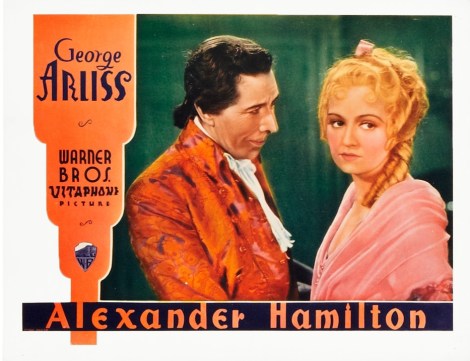
Next on Friday, April 7 at 4:15 PM EDT is the “first version” of the recent hit Broadway musical, HAMILTON. GA co-wrote the play – no musical numbers in this version – that tells the story of the first Secretary of the Treasury’s extramarital affair. When this film was made in the Spring of 1931 it was decided to rename it ALEXANDER HAMILTION, perhaps to avoid confusion with the British Lord Hamilton and his extramarital affair. Is this movie dry stuff? We think not. Check it out yourself.
This card dates from World War II and was sent to Drusilla Pierce, one of the Arlisses’ California friends. Written in Mr. A’s distinctive handwriting, a comment on the left side states, “(Dictated) Flo has trouble with her eyes and can no longer read or write. I am her secretary, Geo”
The main note states, “Drusie, We have just got your Xmas card. We are not sending out any cards this year, but this is just to acknowledge yours. We get very homesick for America and our old friends. It makes us happy to know that you remember us. With love from both of us.”
Up above Mr. A signs both for himself and Florence. Though undated, I would guess that this card was sent in late 1942 and 1943.
I am pleased to announce the publication of our new book. This is an entirely new work of research where we can now share Mr. A’s daily accounts of living in World War II London through his letters that he wrote to friends. These letters have never been published before and offer a personal account of his daily life that at times are amusing and sometimes sad. In addition to sheltering from the nightly bombing attacks by the German Luftwaffe, Mr. A also was the caregiver to his wife, Florence, who had lost her eyesight and was coping with a variety of other ailments.
Arliss decided to spend the war years in London, literally Ground-Zero for German bombers, when he could have joined his friends in sunny California. If he regretted this decision, he never even hinted at this in his many letters. His daily life included nightly aerial assaults from Nazi planes, V-1 and V-2 rockets flying over his home. Throughout these bombardments, Arliss maintained a lively correspondence with his American friends who were safely located in the states, as well as British friends who were safely out of harms’ way in other parts of Britain.
Mr. A had written two volumes of memoirs, the second being published just as the war broke out. Far from being antique writings that reflect a bygone age, this new work is a third volume of his memoirs that vividly describe perhaps the worst time in his life. The George Arliss wartime letters vividly echo the 21st century trauma endured by the COVID lockdowns and the devastation of the Russo-Ukraine War. The book is extensively illustrated with rare photographs, maps of the London bombing attacks, and appendices documenting his stage and film work.
Excerpts from the Kirkus review: “… (Arliss) was, as Fells observes, a ‘prolific letter writer,’ one who managed, no matter who the correspondent was, to combine great generosity and candor with a lighthearted wit. The author collects here a trove of communications that date from 1909 to 1945, the year before Arliss’ death, the most intriguing of which were written in England during World War II. With astonishing composure, Arliss relates the ‘harrowing times’ he lived through, especially the daily air raids mercilessly waged by German fighter planes, a dangerous threat that made the ‘blackness of the night rather terrifying.’ Moreover, in addition to the perils and deprivations the war delivered, Arliss had to contend with an ill wife who was losing her sight: ‘My life is violently changed from the days that were all too short for my liking. Now, I am with Flo all day and every day; in addition to her nervous condition, her eyes are so bad that they do not allow her to either read or write; so we are cut off from the theatre and the cinema; it is more than a year since I visited either.’ Fells supplies readers with astutely informative commentaries regarding the circumstances of each letter, including Arliss’ interlocutor, and adorns the book with marvelous pictures of the artist, his friends, and various miscellany like playbills….”
In his one-man show at the Royal Festival Hall in 1966 Tony Hancock performs a stand-up routine which has changed little since the 1950s. In one section he does some impressions: Robert Newton as Long John Silver (from the 1950 film), Charles Laughton in Mutiny on the Bounty (1935). “Now then – here’s a cracker – one for the teenagers – George Arliss” says Hancock. He purses his lips and forms a monocle with thumb and forefinger. The audience laugh but Hancock looks puzzled, “What do you mean never heard of him ? He’s only been dead forty years !”
Asked to name British actors who had won an Oscar George Arliss (1868-1946) would feature in few replies and yet he was the very first British Oscar winner as well as the earliest-born actor ever to win the award. Already a star of the Broadway stage in the 1910s he became one of the few actors to successfully transition from silent films in the 1920s to talkies in the 1930s. This year marks the centenary of his first film “The Devil” (1921). As a Hollywood producer at Warner Brothers he is credited with discovering and promoting such talent as Bette Davis, James Cagney, Randolph Scott and Dick Powell. He deserves to be remembered.
Augustus George Andrews was born in London the third son of a printer and publisher. Fascinated by stories of the theatrical life by 18 he was playing small parts in melodramas at the Elephant and Castle Theatre. After a decade of provincial touring he returned to London and joined Mrs Patrick Campbell’s company. She took the troupe to America in 1901 and Arliss was an immediate hit on Broadway playing opposite her in Pinero’s “The Second Mrs. Tanqueray”. Despite planning only a six month stay in America he was largely based there for the rest of his working life whilst also maintaining homes in England.
At the height of his Broadway fame in 1911 Louis Parker wrote a play on the life of Disraeli specifically for him. It proved a gold mine – he played it for five years on stage, made a silent film of it in 1921 and a sound film in 1929. It was this latter film which brought him his Best Actor Oscar. Playing opposite him was his wife Florence who he had married in 1899.
In 1912 Arliss spent six months in Boston with “Disraeli” where he was befriended by the local socialite and arts patron Isabella Stewart Gardner (then 72). In his autobiography he later gave his light-hearted views in praise of Bostonian older women: “When you are there should you be seeking companionship – female companionship – don’t go to the dance halls amongst the flappers, but pick out some lady, – almost any lady, over seventy, and if she takes to you, you will have the time of your life. But don’t be put off by some immature substitute in the fifties or sixties; be sure that she has reached the allotted span of life. At seventy the Boston lady says to herself, ‘I have done my duty as a wife and mother … now I am going to have a good time.’ But before you attach yourself to the lady, you must be sure that you are in good physical condition; you will need all your strength”.
In 1917 he appeared as the American founding father Alexander Hamilton in the self-penned play “Hamilton”, a somewhat different piece to the recent hit musical of the same name, with the aim of conveying that the founding fathers were, “real people, and not merely a procession of nice grey-headed old gentlemen”. The Hamilton tour closed prematurely in Boston in 1918 due to the unrest of World War I and venue closures caused by the Spanish flu pandemic.
Ever keen to recycle good material Arliss filmed “Hamilton” in 1931 as an early sound film. His experience as a stage actor meant that, in his 60s, Arliss was perfectly placed to exploit this new medium of “talking pictures”. A contract from Warner Brothers gave him a large amount of artistic control and led to string of successes, often remakes of his previous stage or silent film hits such as “The Green Goddess” and “The Man Who Played God”. The latter gave Bette Davis her first leading role.
The production team Arliss assembled made ten films before Warners’ production chief Darryl F. Zanuck resigned and Arliss followed him to his new 20th Century Pictures company. The hits continued and in 1934 he was voted British film-goers favourite male star and gushing newspaper adverts at the time referred to him (pace Tony Hancock) as “The inimitable George Arliss” who “holds his audiences spellbound for reel after reel”.
As an actor his distinguished patrician style made him perfect for portraying powerful historical figures. “An actor from whose Atheneum manner I sometimes derive a rather humble pleasure” Graham Greene noted. Among his greatest successes in addition to Disraeli were Wellington, Rothschild, and Richelieu. Surprisingly he only once played in Shakespeare, as Shylock. After retirement he said the only character he regretted never having been able to play on screen was the Vicar of Wakefield.
Having previously said he would only retire “when they cut my salary. A sure indication that an actor’s sun is setting.” In 1937 he retired from the screen because his wife “my beloved Flo” was going blind. “She needs a companion, and I have applied for the post” he explained.
They again revived “Disraeli”, this time as a radio production for Cecil B. DeMille. They returned to their London house in Maida Hill in 1939 and despite a film offer from Darryl F. Zanuck they saw out the war in England and never returned to America. Their London property survived the Blitz but a holiday home they owned in St. Margaret’s Bay in Kent was destroyed in 1942 by a shell from the German battleship Gneisenau when she was dashing up the English Channel with the Scharnhorst. A favourite location, Arliss had spent many summers there between theatrical seasons and had seen Blériot land on the nearby cliffs in 1909 and Zeppelins attacked by British fighter planes during World War I.
Modest and self-effacing, Arliss (“Uncle Gus” to his relatives) had survived the excesses and monstrous egos of early Hollywood unscathed. Unhurried and leisure loving – though walking four miles each day – he was as dignified and poised as many of the characters he played. He was a campaigning anti-vivisectionist and a strict vegan saying “I eat nothing I can pat.”
This Grand Old Man of the screen died of pneumonia at home in 1946 at the age of 77 having been seen out for the last time two weeks before walking near Marble Arch “monocled, gloved and spatted, looking frail and tired, but still the picture of a perfect gentleman”. As a measure of his success he left an estate valued at around £6 million in today’s money. A substantial portion of that went eventually, via his wife Florence who died four years later, to the Council of Justice to Animals and the RSPCA. George Arliss has a star on the Hollywood Walk of Fame in Los Angeles and a gravestone in All Saints’ Churchyard, Harrow Weald.
Reprinted by the courtesy of Best of Britain magazine, May 2021.
Back in the day many new film releases had tie-in novels to publicize the movie. But book sales suffered during the Great Depression, so instead the studios used film fan magazines and newspapers to build interest in the plot. This weekly British newspaper, The Isling-Holloway Press, had been published since 1872 and was keeping up with the times by printing this concise story of THE HOUSE OF ROTHSCHILD with dialogue taken directly from the script. The story appeared in two parts in the October 13 and 20, 1934 editions, respectively. One photo from the film accompanied the first part (see below) and I have added a few more to give a sense of the action.




 ARLISS ARCHIVES
You must be logged in to post a comment.