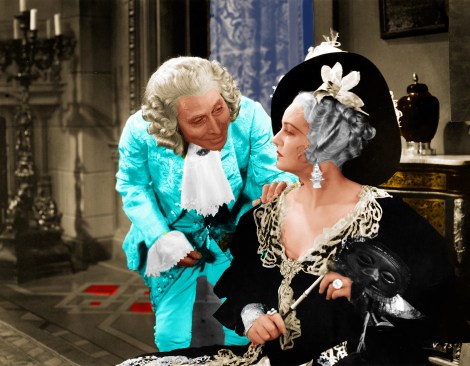
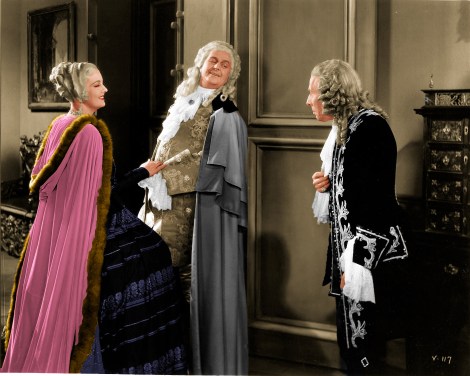
Arliss Alert! VOLTAIRE on TCM this Saturday 7/14 @ 5:45 am EDT

Celebrate Bastille Day this Saturday morning, July 14th, by watching (or recording) VOLTAIRE (1933), your blogmeister’s favorite biopic starring Mr. A. The time is a bit early even if you’re on the east coast – 5:45 am EDT – but that’s why dvr, tivo, etc. were invented. Turner Classic Movies (TCM) is the fortunate channel but if you’re scheduling your timer, be aware that TCM dates everything up to 6 am as the previous day so TCM lists VOLTAIRE as airing on July 13 at 5:45 am EDT even though we know it’s really July 14th at 5:45 am. We prefer to think of this as test to determine whether we’re smart enough to view a George Arliss film, but we’ll all get a passing grade!

Published in: on July 11, 2012 at 4:54 PM  Leave a Comment  

Cardinal Richelieu – Radio Broadcast and Original Lobby Cards

On January 23, 1939, George Arliss stepped before a live audience and a live microphone to broadcast a radio adaptation of his 1935 hit film, CARDINAL RICHELIEU. This prestigious event was one of the highlights of that season’s Lux Radio Theatre, hosted by none other than Cecil B. DeMille. Co-starring with Mr. A were some of the film’s stars including Caesar Romero and Douglas Dumbrille. The ingenue role of Lenore was played by Heather Angel, who replaced Maureen O’Sullivan from the film version. The key role of King Louis XIII was played by Montagu Love who last appeared with Mr. A in the 1931 film, ALEXANDER HAMILTON, where Love played Thomas Jefferson.

Best of all, members of the Arliss stock company were reunited: Ivan Simpson played Richelieu’s confident, Father Joseph (and stepped on some of Mr. A’s lines), Charles Evans played an innkeeper, Doris Lloyd played Queen Anne, wife of Louis, and best of all Florence Arliss played the Queen Mother Marie, who is an adversary of the Cardinal. It is interesting to hear Mr. and Mrs. A exchange harsh words in character rather than the romantic dialogue usually heard in their films. This broadcast was heard coast to coast and by shortwave around the world. As Mr. A says in his curtain speech at the end, a conservatively estimated 30 million people listened in. Today, a show with 5 million viewers is considered one for the record books.

If you weren’t around in 1939, that’s no problem here at the Arliss Archives. Just click (perhaps several times) on the play button below and you will be transported back in time to hear the complete hour-long broadcast:

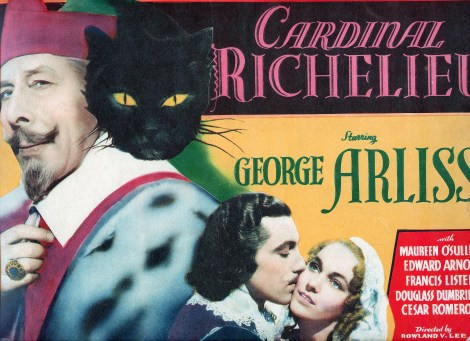
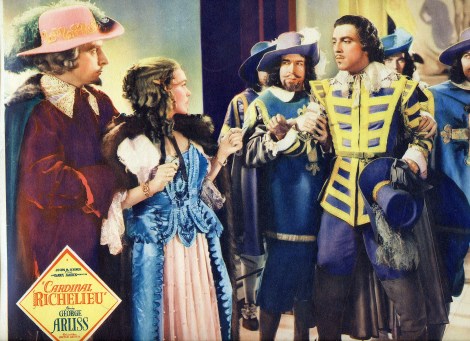
While you are listening, Mr. A suggested you might want to review the original set of eight lobby cards that were issued in conjunction with the film. The 11×14 inch size of each card is too large for most scanners today so we have done our best to squeeze most of the contents into the image space. This is the first card, known as the title card for obvious reasons:

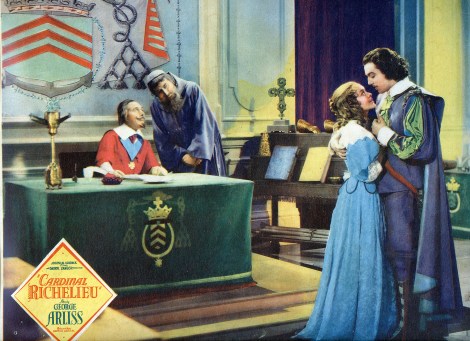
King Louis (Edward Arnold) and his retinue visit Richelieu where he meets the Cardinal’s ward Lenore (Maureen O’Sullivan) and is smitten by her. The villainous Baradas (Douglass Dumbrille on the right) smugly guesses the King’s plans for poor Lenore:

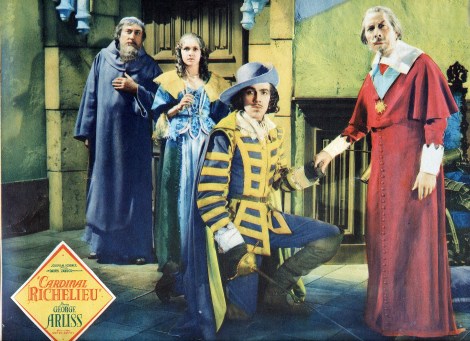
As Lenore is romanced by Andre dePons (Cesar Romero), the Cardinal realizes a way to thwart the King’s lustful intentions and instructs Father Joseph to bring the couple to the chapel so he can marry them:

The King is furious with Richelieu and Baradas sees his opportunity to dethrone Louis and place his weak brother Gaston as a puppet king. But first Andre must be persuaded to turn against Richelieu and join Baradas:

Andre is initially duped and almost murders the Cardinal but Richelieu has a way of explaining things and Andre reveals Baradas’ plot to overthrow Louis in league with Spain:

Richelieu must overtake Queens Marie and Anne on their way to the Spanish border to deliver the conspirators’ secret treaty. That’s Reginald Sheffield on the right, a member of the Arliss stock company. He would become better known as the father of Johnny Sheffield, who played “Boy” in Johnny Weissmuller’s TARZAN films:

The Cardinal manages to catch up to the Queens (Katherine Alexander and Violet Kemble-Cooper) and tricks them into disclosing the treaty by using a simple ruse – he lies!

Since everyone at court believes Richelieu to be murdered by Andre, the Cardinal causes quite a stir when he shows up with the secret treaty. Baradas and his colleagues are arrested for treason, Richelieu is restored to the King’s favor, and the Cardinal suggests to his Majesty that the best way to celebrate is to give thanks to God:

The End

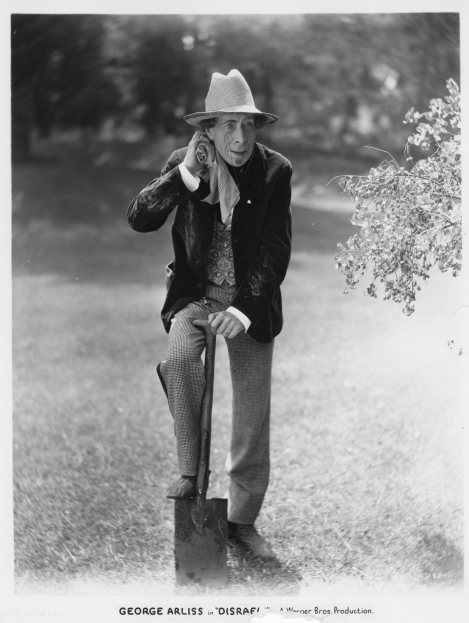
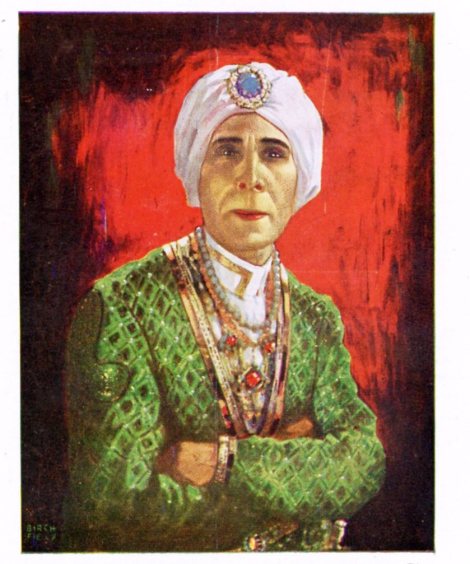
A nice portrait of Mr. A in the title role, originally in b/w that we transferred into color:

The Last Gentleman

Comedies about dysfunctional families are common now but George Arliss made this darkly-humored film concerning the impending death of the family patriarch in 1934. In many respects, THE LAST GENTLEMAN is quite modern in its unsentimental approach to quarreling family members, deceitful sons, and having the last laugh from beyond the grave.

Mr. A plays Cabot Barr, a flinty New Englander who bears a sufficient likeness to John D. Rockefeller, Sr. that the film opens with a special legal disclaimer stating that Cabot Barr’s resemblance to any persons living or dead is purely coincidental:

Barr lives with his friend Henry Loring (Ralph Morgan, brother of Frank “Wizard of Oz” Morgan) in a Boston mansion while estranged from his entire family:

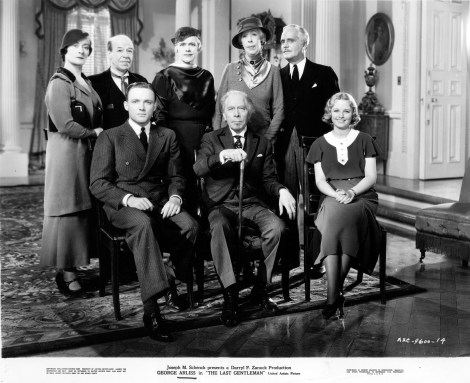
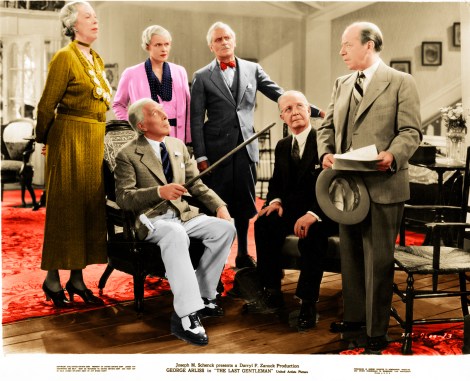
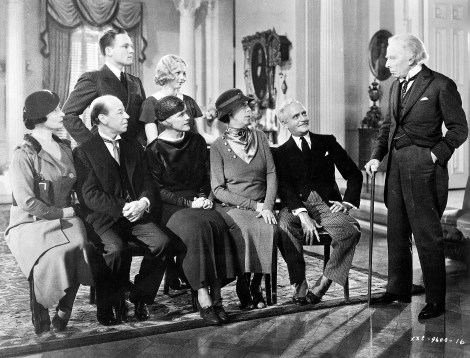
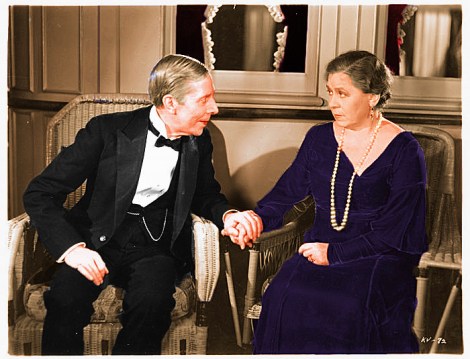
A charming family portrait, standing left to right: scheming son Judd Barr and his wife Netta (Raphaela Ottiano and Donald Meek), estranged daughter-in-law Helen (Janet Beecher), estranged sister Augusta (Edna May Oliver), companion Henry Loring; seated: disinherited adopted grandson Allan (Frank Albertson), Cabot Barr, and unacknowledged granddaughter Marjorie (Charlotte Henry):

Cabot decides to summon his relatives for a memorial service for another sister, a missionary in China who may or may not be dead. He really wants to see them again before finalizing his will:

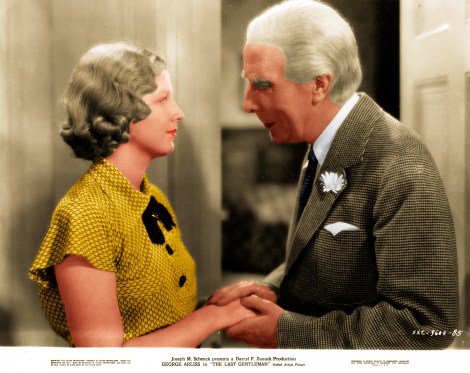
He speaks to his daughter-in-law Helen for the first time in sixteen years after he expelled her from his home because she had a daughter instead of a son and heir. Cabot refuses to speak to his granddaughter Marjorie until she sabotages the memorial service by setting off all the alarm clocks in the house:

Cabot rules his household with an iron fist and no one is spared his wrath especially his butler Claude (Edward Ellis), an ex-convict:

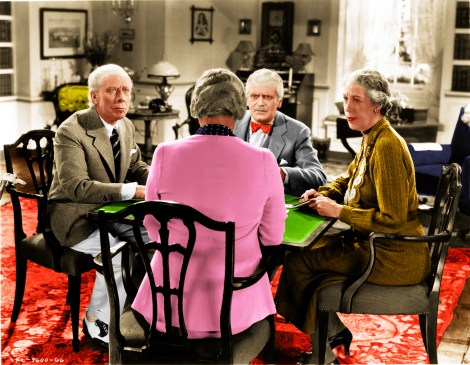
Granddaughter Marjorie has all the contrariness of a true Barr so Cabot takes a liking to her in hopes she will marry Allan, his sister Augusta’s adopted son, in order to continue the family name. While encouraging the romance, Cabot runs roughshod over a rubber of bridge:

Film reviewers were startled by the strong resemblance between the fabulous Edna May Oliver, seated on the right, and Mr. A:

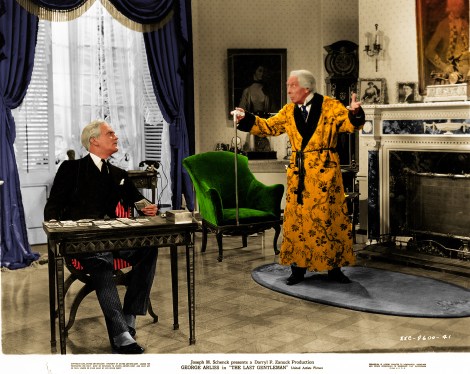
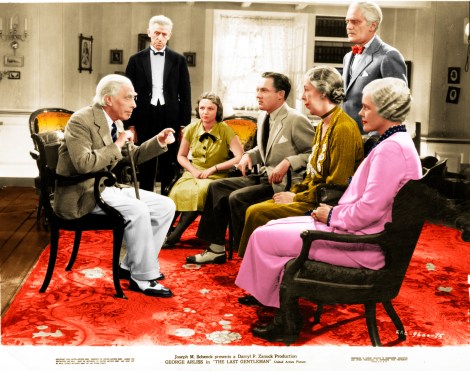
Cabot’s spendthrift son Judd (standing), tries to have his father declared incompetent by a psychiatrist (seated to Mr. A’s right) so he can gain control of Cabot’s money:

Fending off Judd’s challenge depletes Cabot as he realizes that his son is not only a wastrel but a scoundrel. He conceives an idea to have the last word after his death. Frank Albertson plays Augusta’s adopted son Allan, whom Cabot hopes to marry off to Marjorie to continue the name:

Suddenly “feeling very old,” Cabot says goodbye to Marjorie and retires to his bedroom where he later dies:

Following the funeral, the family gathers at the Barr home to hear the reading of the will. They are startled to discover that Cabot himself reads his will and settles old scores in the process. How he does this was once so secret that theater managers would not permit seating during the last ten minutes of THE LAST GENTLEMAN, and even the New York Times movie critic declared that “neither wild horses nor the rack” would drag the story’s solution from his lips. But it’s great fun and provides a memorable finale!

Production Shots

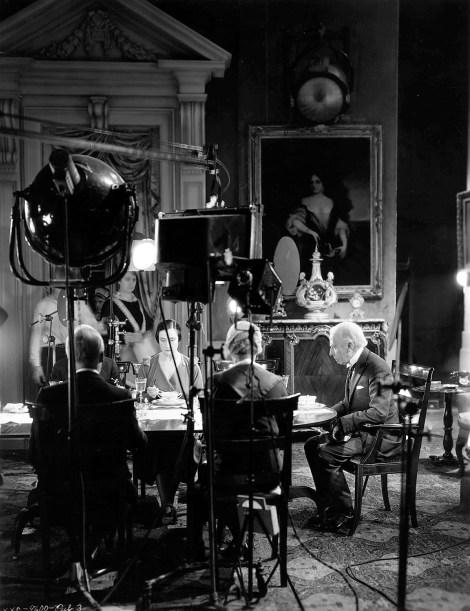
The Barr family is momentarily quiet as its patriarch says the Grace Before Meals. The scene appears serene…

…until we take a look from the side to see the confusion of wires and lights needed to film the scene:

This production photo is scanned directly from an 8×10 inch negative. The expressions on everyone’s faces says it all:

A Special Tribute for the Fourth Of July – Alexander Hamilton (1931)

The best playwrights in the United States offered new works to George Arliss after his five-year run in DISRAELI. After a few false starts, Mr. A settled on a fledgling effort written by a housewife in upstate New York named Mary Hamlin. She wrote extensively about her collaboration with Mr. A, both on the 1917 play, HAMILTON, and later the 1931 film version retitled ALEXANDER HAMILTON. This post will focus on the Warner Bros. film and Hamlin’s contemporary letters from Hollywood to her NY home, and her later memoirs.

Hamlin participated in story conferences that producer Darryl Zanuck ran roughshod over with his non-stop talk and his haywire ideas, most of which he forgot about. One idea stuck – to open the film with Gen. George Washington making his Farewell Address to his troops at the end of the Revolutionary War in 1783:

Alan Mowbray was hired to play Washington, his first of three Arliss films. Hamlin recalled that Mowbray refused to rehearse his part in front of Mr. A and performed only for filming.

The studio had planned to film Mr. A’s first starring success, THE DEVIL, from 1908. But he disliked the play by 1931 and Warners went scurrying for another vehicle. Zanuck was unaware of the HAMILTON play that Arliss had co-authored with Hamlin, but when he learned of it insisted that it be filmed. Mr. A felt he was much too old for the role but Zanuck waved aside his objection.
Here Washington tells Hamilton he wants to return to Mount Vernon to live out his days in peace, but Hamilton tells him he has other plans.

Eight years later in 1791, the temporary capital of the U.S. is located in Philadelphia; Washington is the first President and Hamilton is the first Secretary of the Treasury. He is also married to Betsy, played by silent screen star Doris Kenyon:
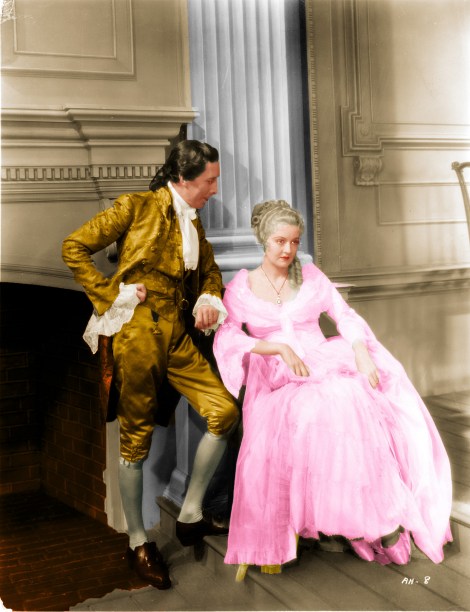
But Hamilton has determined political opponents in James Monroe (Morgan Wallace) and Thomas Jefferson (Montagu Love), who adamantly oppose Hamilton’s plan to establish a strong central banking system fearing it will encroach on the sovereignty of the states:
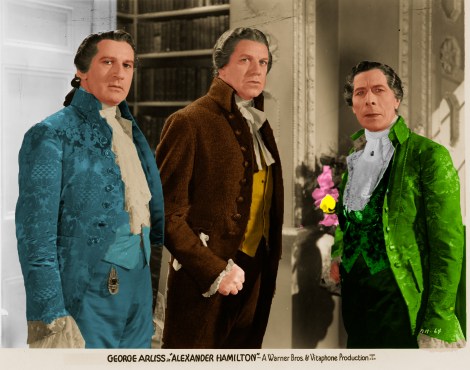
Although Monroe and Jefferson could hardly be portrayed as villains, Mr. A cleverly cast Wallace and Love, two well-known supporting actors who specialized in playing bad guys, in the roles to subliminally influence the audience’s perception of these characters.

Jefferson and Monroe need Hamilton’s support to locate the Capitol in the South, believing that he will champion his home state of New York. Senator Roberts (Dudley Digges), seated in the middle, has a personal grudge against Hamilton who refused to support his nomination for ambassador to France:

Monroe, Jefferson and Roberts confer with Hamilton about his “Assumption” bill whereby the federal government would assume the states’ obligations to pay the Revolutionary War veterans their pensions, and also about Jefferson’s “Residency” bill to establish the U.S. Capitol:
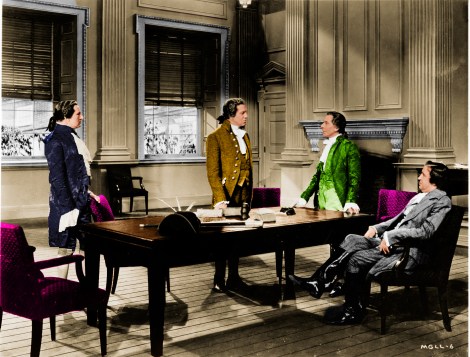
Jefferson knows that without Hamilton’s support, the Capitol will not be located in the South. They agree to a compromise – the Capitol will be located on the Potomac by northern Virginia, in return for Monroe and Jefferson’s support of Hamilton’s “Assumption” bill to create a federal banking system that will pay the veterans’ pensions:
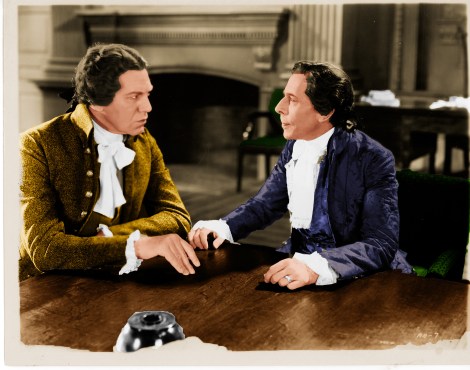
But Sen. Roberts incites a crowd against Hamilton, saying that he won’t help them. When Hamilton appears, one man throws a rock nearly hitting him:
Charles Middleton is the tall actor on the left who was apparently slated to play Chief Justice John Jay, but appeared only in this uncredited role.

Hamilton learns that his assailant was incited by Sen. Roberts. He also learns the man is a War veteran and jokes, “You must have been a sharpshooter because you nearly got me.” He orders the man released:
Hamlin said this unidentified actor had a wife who was dying in the hospital but he needed the job to pay the bills. Once his scene with Mr. A was completed, a studio car took him directly to the hospital.

The jeering crowd now has only cheers for Hamilton:
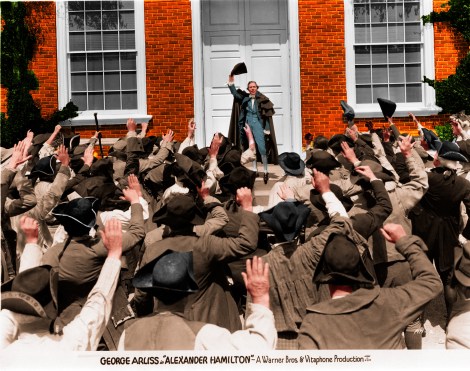
Betsy’s father, old Gen. Schuyler, arrives with news that her sister in England is seriously ill and is calling for her. Betsy sails for England leaving her beloved husband:
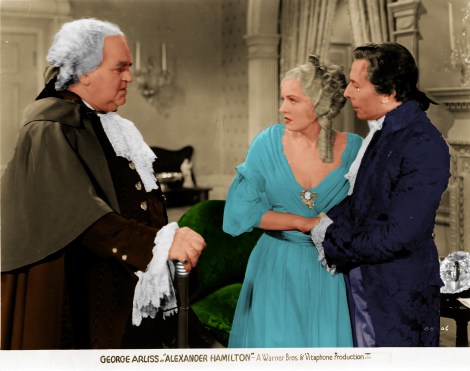
Veteran screen actor Lionel Belmore plays “old” Gen. Schuyler but Belmore was only a year older than Mr. A.

Ne’er-do-well Reynolds (Ralf Harolde) was fired by Hamilton from the Treasury for dishonesty. He is buying up the veterans “worthless” pensions for pennies on the dollar in the hope that the federal government will eventually redeem them at full value. Reynolds suggests to Sen. Roberts how Hamilton’s reputation can be destroyed and his political career ended:
Hamlin noted that Dudley Digges (Sen. Roberts) had directed the 1917 stage version of HAMILTON and also played the part of Reynolds on the stage.

Late one night during Betsy’s extended absence, a young woman (June Collyer) calls on Hamilton. She claims she is the widow of a War veteran and is impoverished. She asks if she can obtain a loan from the Treasury:

Hamilton takes pity on the lonely widow and makes her a personal loan. He walks her home but then…..
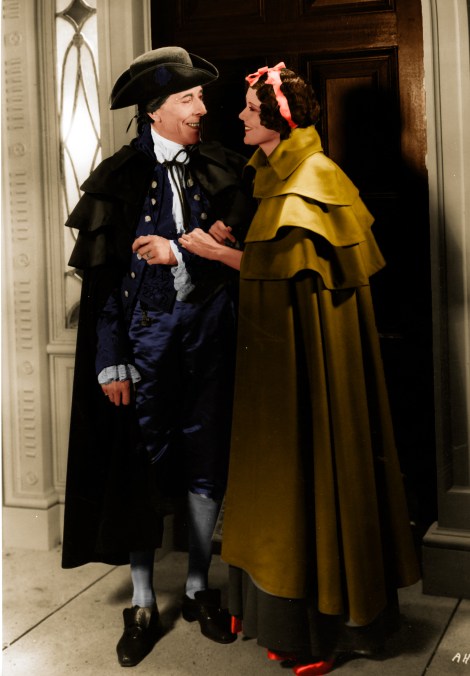
A reception is given to celebrate Betsy’s return home. Reynolds turns up as an uninvited guest to blackmail Hamilton – the lonely widow is in fact Reynolds’ wife!

Sen. Roberts springs the trap to ruin Hamilton – he claims that Hamilton made secret payments to Reynolds to act as his agent to buy up the veterans’ pensions knowing that when the Assumption bill passed Hamilton would enjoy a windfall:
Hamilton can defend himself only by explaining the real reason for paying Reynolds, as blackmail to hide his affair with Reynolds’ wife.

The conflicting stories become public and Hamilton faces the ruin of his marriage and of his career. But he and Betsy become reconciled to face an uncertain future:
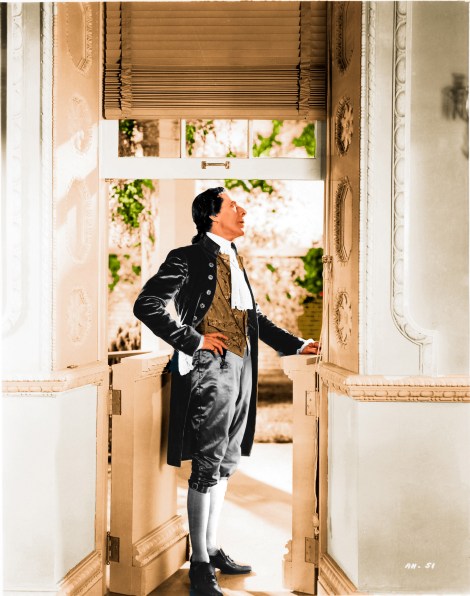
Jefferson, Monroe and the leaders of both political parties assemble to tell Hamilton, or so he fears, of his dismissal from the Government and the defeat of his Assumption bill:
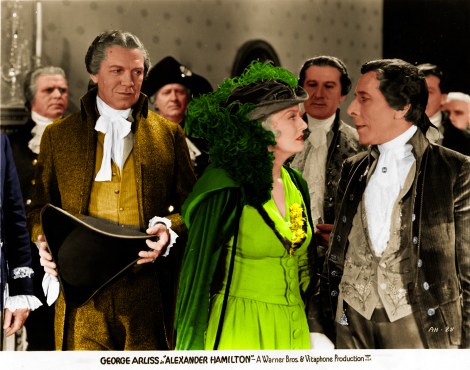
The meeting is interrupted by the arrival of President Washington who personally assures Hamilton of his confidence in him and the news that Congress has passed his Assumption bill.
Hamilton conveys his gratitude and observes that it doesn’t matter what happens to Alexander Hamilton the man. By passing the Assumption bill, Congress has established the credit of the United States and ensured the future prosperity of the nation. The End.

Production Photos:

Even outdoor filming does not interrupt Mr. A’s 4 pm tea break:
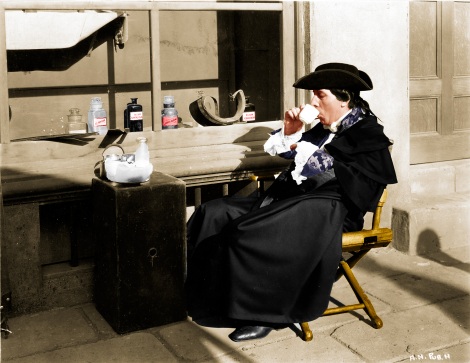
June Collyer and Mr. A had only one scene together, part of which was filmed outdoors at night. Here they seem to be standing by waiting for nightfall to film the scene:

Enlarging this photo shows that Mr. A is wearing his famous monocle, in other words he is posing as himself and not in character.

A rare photo with John Adolfi, director of seven of the ten Arliss Warner films. Mr. A shows Doris Kenyon and Adolfi a 200 year-old watch that he wears in the film:
Mary Hamlin was an expert on early American furniture and supervised the settings used and provided by W&L Sloane Co. Hamlin asked the Sloane manager how much Warner Bros. paid for the furniture and was told that it was being lent to the studio for free in return for a screen credit. When Hamlin asked why the company agreed to this arrangement for only one film, the manager said, “Because it’s a George Arliss film.”

Another rare photo of producer Darryl Zanuck with Mr. A on the set. Hamlin learned in time to share Mr. A’s high regard for Zanuck, that despite Zanuck’s verbosity he was something of a genius:

Hamlin and Mr. A corresponded until his death in 1946, and Hamlin later wrote that he was a gentleman in every sense of the word. He insisted that she be paid 75% of the royalties on the play even though he rewrote most of it. Her letters from the studio in 1931 give a fascinating glimpse of the work environment. She was surprised that John Barrymore looked so old and assumed he would no longer be playing leading man roles. She met Noah Beery, Sr., who appeared in the Arliss film, THE MILLIONAIRE (1931). Commenting on Mr. A, Beery said, “He’s such a nice man!” Hamlin’s writings confirm that George Arliss was the prime creative force in his films, but almost never taking credit for anything but his acting.

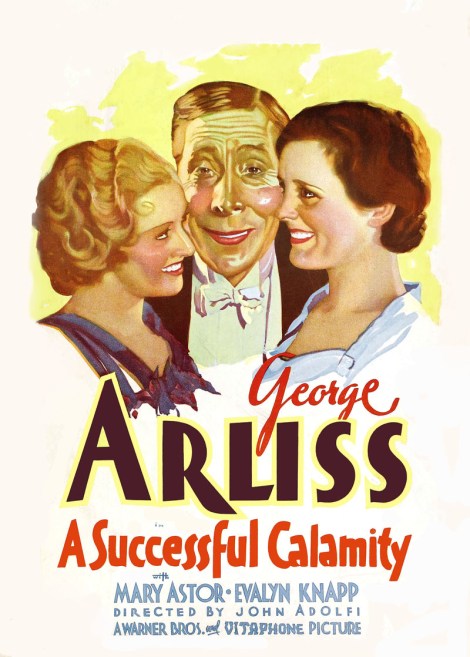
A Successful Calamity (1932)

One of the more obscure films in the Arliss Canon, A SUCCESSFUL CALAMITY is happily back in circulation from Warner Home Video as part of a three-disc dvd set, the George Arliss Signature Collection. Think of Mr. A in “Father Knows Best” and you’ll know what to expect. The film is based on a 1917 play written by Clare Kummer who specialized in feather-weight domestic comedies. The play gave a needed change of pace to William Gillette who had been playing Sherlock Holmes on the stage since 1899. Warner Bros. may have figured that if this play was good enough for “Sherlock Holmes,” it was good enough for “Disraeli.”

Mr. A plays international financier Henry Wilton who has just returned from a year abroad in the service of the President of the United States. Eager to return to his family, he arrives home a day ahead of schedule and finds only his butler, Connors, there to greet him. Wilton decides to visit his family members at their various appointments. His son Eddie (William Janney) is playing in a polo match:

Eddie is sidelined by his coach, Larry Rivers, played by Randolph Scott. The man in the derby is Grant Mitchell playing Connors:

Wilton’s daughter Peggy (Evalyn Knapp) is in love with Larry Rivers but engaged to a nerdish young man:

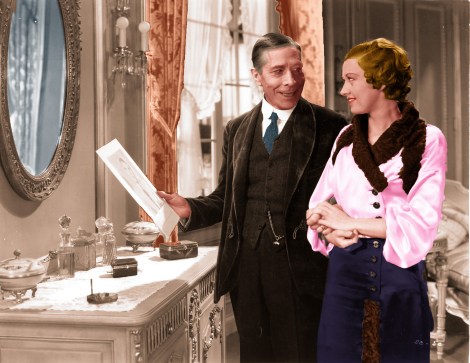
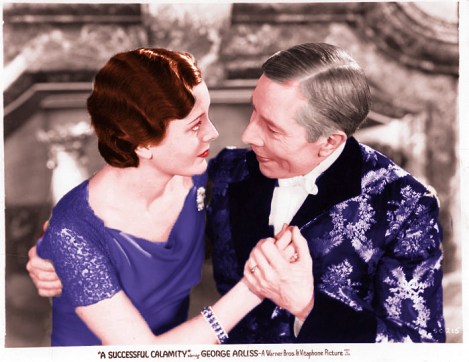
Emmie (Mary Astor) is Wilton’s wife by a second marriage. Earlier he observes that he was criticized by some for marrying a woman much younger than himself. He learns from Emmie that they are “patrons” of a handsome young pianist, Pietro, who is much closer in age to Emmie.

Wilton despairs of having a quiet evening at home with his family given their busy social lives. He wonders if the poor have the same problem, but Connors tells him no, because “the poor don’t get to go very often.” This gives Wilton an idea:

Wilton breaks the “news” to Emmie that they are “ruined” and must sell everything. She cancels her evening’s plans to stay home with him:

Wilton also informs Peggy and Eddie of their ruin and they likewise cancel their plans and find themselves enjoying a simple dinner with their dad and step-mother to plan their future:

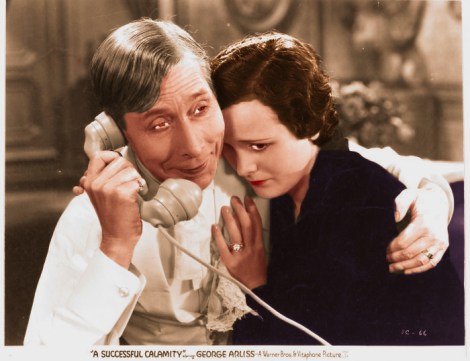
Before Wilton can tell Emmie the next day that he is not ruined after all, he learns that she has packed up all her jewelry and left in a taxi with her protege Pietro. Fearing the worst, Wilton tells Larry, Peggy and Eddie that Emmie left because she was afraid to be poor:

But Emmie has not left him, she only sold her jewelry to raise money and Pietro came along because he knows a good pawnbroker. Wilton’s family reflects on their brush with poverty by wondering why they were happier spending time at home. Wilton explains they were happy because “the poor don’t get to go very often.” The End.

Warners granted Mr. A a rare concession that was not even mentioned in his contract – the studio paid the cast (but not Mr. A) an extra two weeks salary so they could rehearse prior to any filming. The script for A SUCCESSFUL CALAMITY was then performed as play from beginning to end before an audience of studio workers including the director. The script was revised based on audience reaction and only when the script was finalized would filming begin.

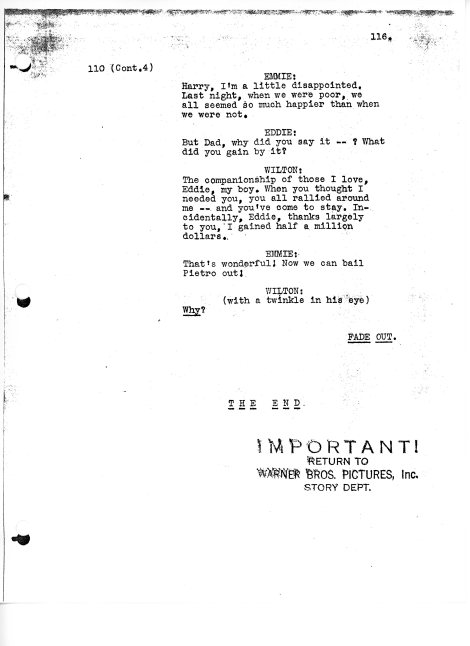
Yet refinements to the script continued even during filming. The story is simple enough but was filled with dangerous shoals for its characters. For example, Peggy and Eddie could easily have been played as spoiled brats but instead come across as likeable (but spoiled) youth. The same can be said of Emmie although Mary Astor brings an inherent intelligence to her character. Wilton’s claim of being ruined seems like a nasty trick and in the script he admits to his family that it was a cruel joke:

In the film Wilton never tells them it was a hoax and indeed it seems that they are better off not knowing. The hoax serves as a reality check making Eddie and Peggy realize that they have to support themselves instead of living off Dad. The viewer is left with the impression that they are better people thanks to the “cruel joke.” Thus, the ending dialogue was changed from the final script and the story is more effective as a result:

A SUCCESSFUL CALAMITY satirizes modern “futuristic” music and art deco design but is most surprising in its focus on the travails of the wealthy during the height of the Great Depression in 1932. Perhaps the public enjoyed being voyeurs among the rich while forgetting their more basic problems. In any event, the film was profitable for Warner Bros., as were all of the Arliss films, with gross revenue of $642,000 and netting a profit of $127,000, or 25 percent over costs. Not bad for a story as light as pixie dust.

The Doctor is In – Dr. Syn!

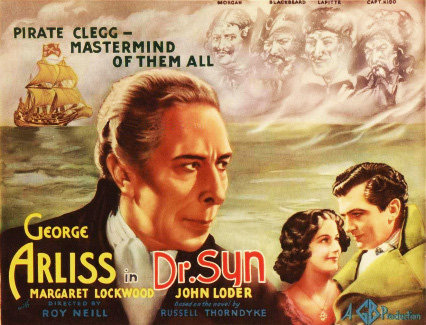
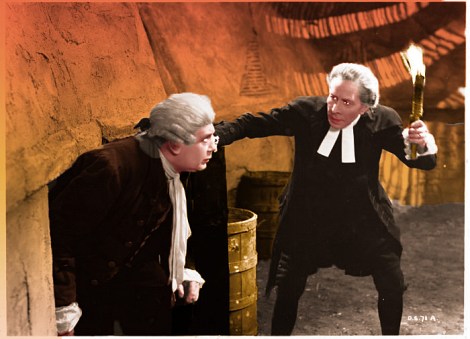
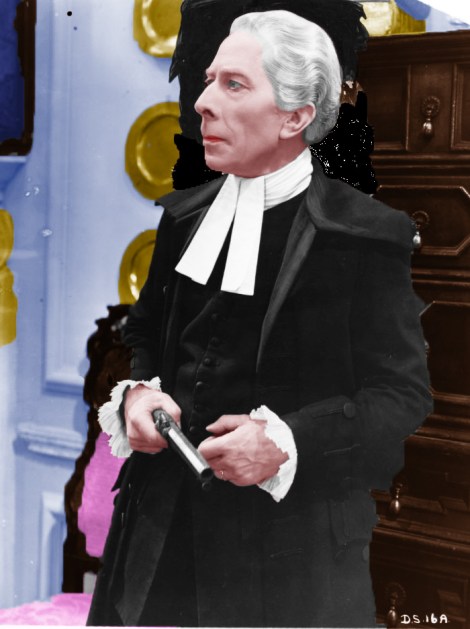
George Arliss as action hero? Not likely but Mr. A comes close with DR. SYN (1937), a corking good pirate yarn based on a popular novel by Russell Thorndyke. The novel is a thematic blend of Robert Louis Stevenson and Sigmund Freud that was so successful Thorndyke wrote several sequels. The novels still have quite a following in the UK. The story is set in Dymchurch, a seaside village in Kent, England, in the year 1800.

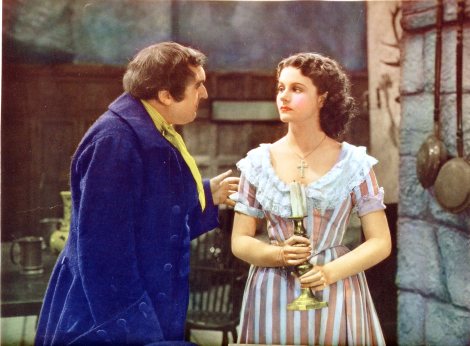
Mr. A plays the saintly vicar, Dr. Syn, who looks kindly on the blossoming romance between the orphan Imogene, played by Margaret Lockwood, and Denis Crabtree, son of the village squire, played by John Loder:

Dymchurch is plagued by nighttime apparitions of ghost riders on the nearby Romney Marsh but the main business of the villagers is a little fuzzy. Turns out the leading occupation is smuggling to avoid the exorbitant excise taxes imposed by the King. The ringleader is known only as “The Scarecrow.”

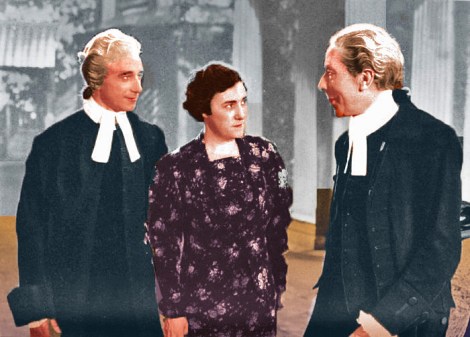
Dr. Syn becomes alarmed for his parishioners when a contingent of the King’s revenue patrol arrives at Dymchurch to investigate smuggling activities. Captain Collyer suspects that the nightly ghost riders are a cover for the smugglers and that Dr. Syn knows a lot more than he cares to tell:

Collyer learns that a number of the villagers were the crew of the notorious pirate, Captain Clegg, who was hanged twenty years earlier and lies buried in the churchyard cemetery – or does he? Dr. Syn alerts the sexton to spread the alarm:

Dymchurch schoolmaster Mr. Rash has designs on Imogene and tries to blackmail her with threats to reveal that she is the daughter of Captain Clegg:

As Capt. Collyer begins to close in, Dr. Syn realizes that he must take action to protect the village. Of course, not only is he “The Scarecrow,” he is Captain Clegg….

…and Imogene is his daughter. Mr. Rash must be silenced:

The discovery of Mr. Rash’s corpse results in the convening of an inquest where Capt. Collyer cross-examines Dr. Syn and forces him to admit his true identity. Before he can be arrested, the villagers intervene to foil Collyer’s men:

With Collyer’s men in hot pursuit, Dr. Syn stops by the church long enough to marry Denis and Imogene, then rejoins his old crew on their old ship, which was kept ready and hidden in a nearby cove, where they sail away for further adventures.

DR. SYN is technically George Arliss’ final film, but we at the Arliss Archives prefer to regard it as Mr. A’s most recent film. On the set, Alan Whittaker is Mr. A’s stand-in, Maude Howell serves as associate director, and Mr. A is in his 70th year:

Queen Mary attended the film’s London premiere, and the New York Times gave DR. SYN an enthusiastic review stating that it was better than MGM’s TREASURE ISLAND (1934). The film is widely considered the best of Mr. A’s five British films and is available on home video in an acceptable (but not restored) dvd edition through various outlets including Amazon.

A Centennial Salute to DISRAELI – the Play, the Silent Film, the Talkie, the Radio Broadcast

I doubt that there is another dramatic work, excepting Shakespeare’s plays, that has been translated into so many different mediums in the performing arts as DISRAELI. First debuting as a play in 1911, it was turned into that most peculiar relative of the spoken stage – a silent film, in 1921. At the end of that decade this vehicle was reinvented as an Academy Award-winning “talking picture.” Nearly a decade later, the play-cum-silent film-cum-talkie was turned into an hour-long radio broadcast heard around the world via the CBS network and shortwave in 1938. Perhaps the most remarkable aspect of DISRAELI is that ALL of its various incarnations starred the same actor – George Arliss.


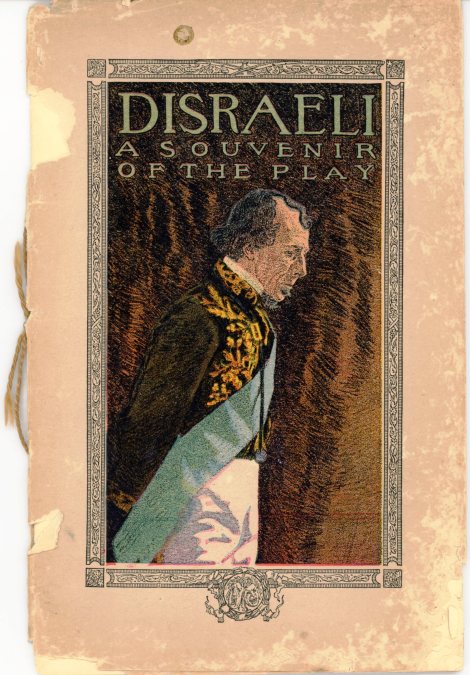
A Souvenir Program from the 1911-12 season

The play was written specifically for Mr. A by the then-famous playwright Louis N. (for Napoleon) Parker. There was one problem – Parker had never seen Arliss perform on the stage. Then Parker quit saying that a play about Benjamin Disraeli, the British prime minister of the 1870s, couldn’t be written. Mr. A convinced Parker it could be written and explained how. Parker completed his play due largely to its star’s role as midwife.

The final scene where Disraeli receives a telegram he fears will tell him of his wife’s death: Mr. A with Marguerite St. John, the first actress to play Lady Beaconsfield (Mrs. Disraeli) on the stage.

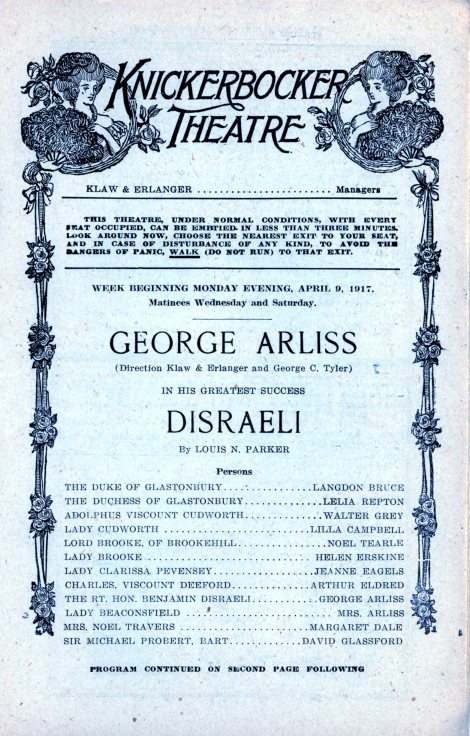
Mr. A starred in DISRAELI for five consecutive years, from 1911 to 1915, then revived it thereafter. Here is the cast for a 1917 revival – note that Florence Arliss plays Lady Beaconsfield. Also, note that the ingenue role of Lady Clarissa is played by the talented, ill-fated Jeanne Eagels:

The 1921 silent film is now lost but a number of stills have survived….

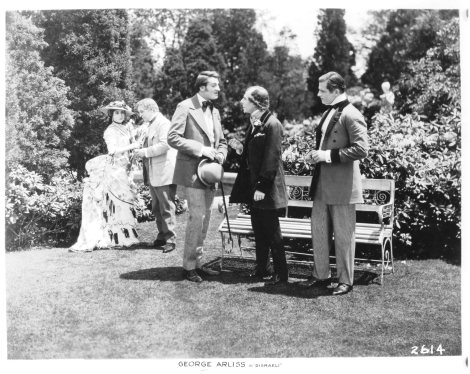
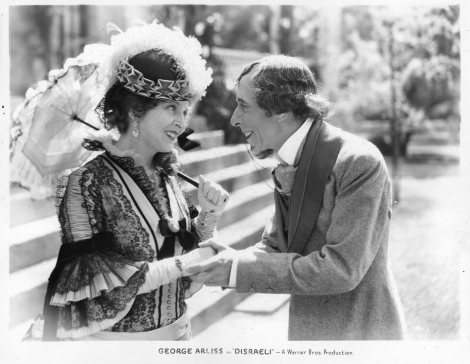
No longer stagebound, the garden party scene was filmed outdoors:

A rare glass slide advertising the silent film in theaters:

Margaret Dale plays the spy, Mrs. Travers. Dale had played the role continuously since 1911 and never missed a performance, not even in this film version.


Florence Arliss as Lady Beaconsfield tries to console her husband: he has just written a bad check – to buy the Suez Canal!

Warner Bros. persuaded Mr. A to make the play into one of the first full-length talking pictures. He did and won the Best Actor Academy Award:

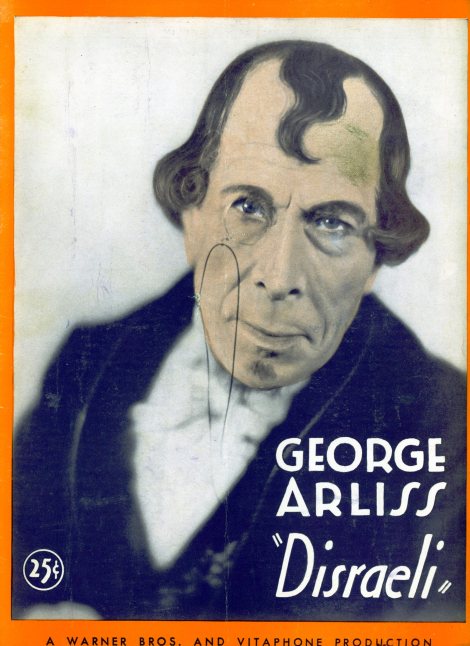
A souvenir program for the 1929 film

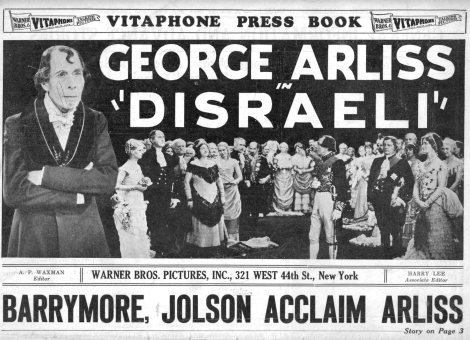
Here’s a detail from the Warner pressbook telling theater owners how to sell the movie to their patrons:

Exteriors were filmed at the old Busch Gardens during the summer of 1929 by ace cinematographer Lee Garmes. This scene looks pretty but Mr. A recalled that it was hot as ….blazes.

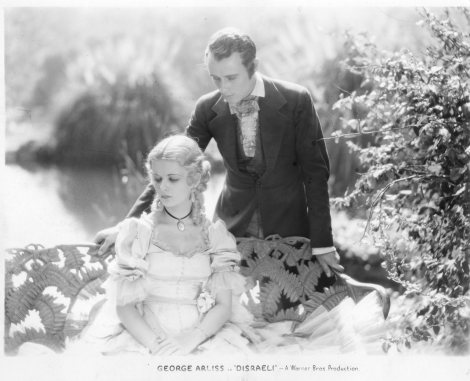
The romantic young couple, Lady Clarissa and Lord Deeford, were played by Joan Bennett and Anthony Bushell:

The 1929 film cast and crew, from the original program:

The ever-reliable Ivan Simpson plays financier Hugh Myers, a fictional character based on the real-life Lionel Rothschild who financed Disraeli’s purchase of the Suez Canal:

A flyer highlighting scenes from DISRAELI:

Outtakes – not every scene made it into the final production:

Disraeli and Gladstone exchange sharply divided political views in the House of Commons – but not onscreen.


Mrs. Travers meets Disraeli – but not onscreen. Doris Lloyd plays the spy, the one time that Margaret Dale missed a performance!
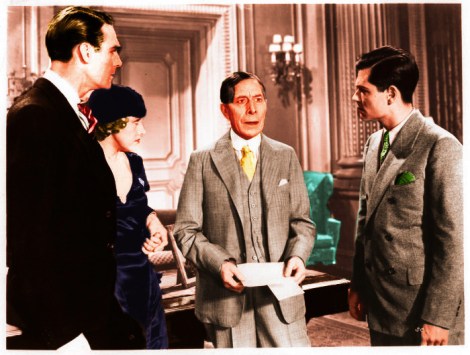

We only glimpse the Prime Minister working in his garden and never to this extent!

Back to the movie:

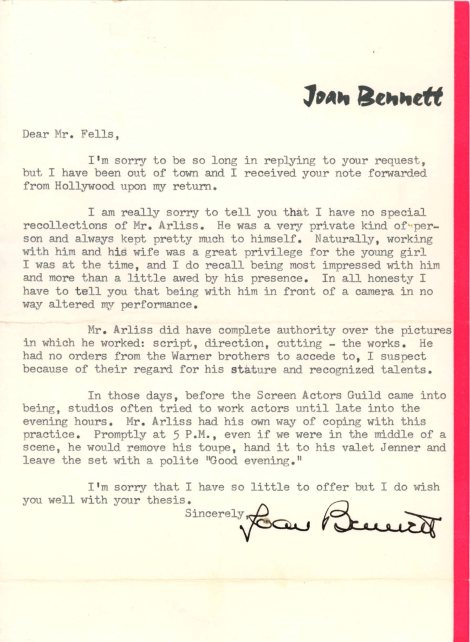
Joan Bennett at the beginning of her very successful career. When I showed DISRAELI in college in 1970, I had the idea to write a thesis and wrote to Ms. Bennett to ask what Mr. A was like to work with. Here is her reply:

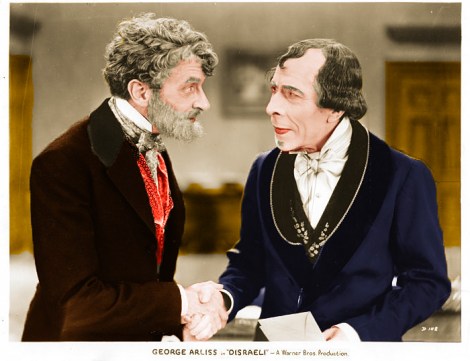
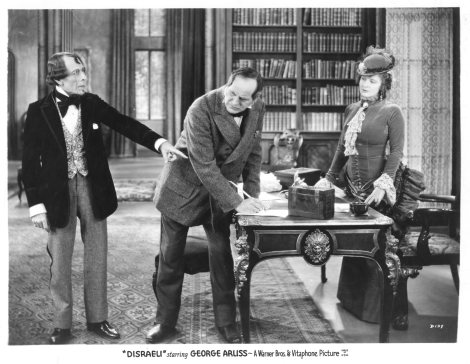
Now about that bad check for the Suez Canal: Congress didn’t invent “stop gap spending.” Here the Prime Minister threatens to ruin the Bank of England if its president, stuffy Lord Probert (David Torrence), doesn’t cover the check:

Probert signs to save the Bank but is dismayed that Disraeli has such power.


In the dramatic payoff, Disraeli confides that as Prime Minister he has no such power, “but he doesn’t know that.”

Here is Mr. and Mrs. A in the final scene involving the telegram again:

On January 17, 1938, George Arliss made his dramatic radio debut on the CBS network with DISRAELI. This live broadcast on the Lux Radio Theater was heard all over the world and brought to the microphone much of the cast of the 1929 film version including Florence Arliss, Ivan Simpson, Doris Lloyd, and David Torrence. Mr. A was nearly 70 years old and noted that more people heard this one broadcast than all the audiences combined from his years performing in the play, the silent film, and the talkie:

Here’s the photo’s original press caption:

Want to hear this broadcast from long ago? It is right at your fingertips so just click below:

The Millionaire

Gasoline price wars aren’t new, although gas stations today seem to compete only to charge the highest price, not the lowest. Anyway, imagine a millionaire – in today’s money, a gazillionaire – who buys an interest in a little gas station as a hobby. His partner is a young man of modest means who has no idea that the elder mechanic is the Warren Buffet of his day. When they are swindled by their competitor, a hilarious case of economic warfare breaks out in the best capitalist tradition.

George Arliss plays James Alden, a Henry Ford-type auto tycoon, who is more or less forced into retirement by his doctor. Florence Arliss plays Alden’s wife:

Alden is doted on to such an extent that he’s in danger of becoming an invalid. The ever-reliable Ivan Simpson plays Davis, the butler:

A then-unknown James Cagney is a fast-talking life insurance salesman who drops his sales pitch on learning that Alden is retired – a “bad risk” for insurance purposes. The salesman helpfully suggests that Alden should look for business opportunities to stay active:

Arliss personally cast Cagney in the role, observing that Cagney had the perfect personality that seemed to say, “Here I am, take me or leave me, and hurry up.”

Alden keeps secret his doctor-defying plan to buy a half-interest in a gas station incognito as a simple mechanic he names Charlie Miller. But the owner, Peterson, played by Noah Beery, Sr., is a crook and sells the other half interest to young Bill Merrick, played by David Manners

The ink on the sale is barely dry when Alden and Merrick realize they’ve been swindled – the road going past their gas station is being closed due to the new highway opening up, and Peterson has the only gas station there!
David Manners, Arliss, Noah Berry. Sr., and Tully Marshall

Alden/”Miller” uses his wits, not his money, and persuades Bill Merrick to obtain a loan from a relative to open a new gas station right across the highway from Peterson’s. Romance also blossoms between Merrick and Alden’s daughter Barbara, played by Evalyn Knapp, and Alden takes Barbara into his confidence:

A lobby card from the lost silent film version, THE RULING PASSION (1922). Here, Alden’s daughter is played by Doris Kenyon. A decade later, Arliss and Kenyon would portray Mr. and Mrs. ALEXANDER HAMILTON (1931) and still later, as VOLTAIRE (1933) and Mme. De Pompadour, respectively:

“Miller” and Merrick battle Peterson head-on by slashing their price for gasoline – seeing how little gasoline cost in 1931 may bring tears to your eyes:

Peterson admits defeat and ends up buying out Alden & Merrick for three times what they paid him. Alden explains to his wife that the only thing wrong with him was boredom and his secret project was the right cure:

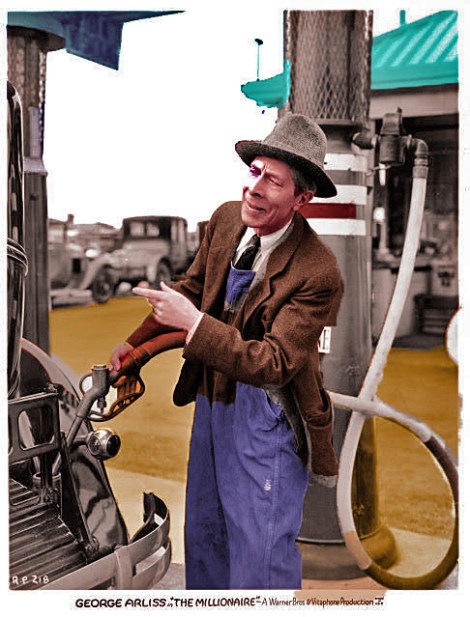
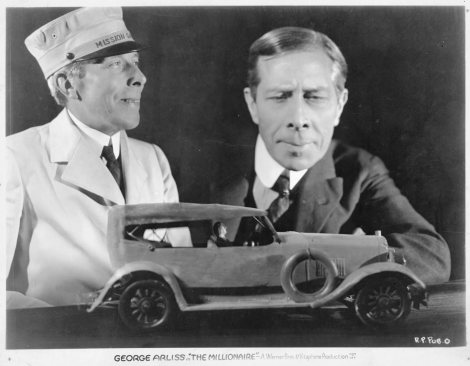
Here’s a nice f/x photo of Alden and his alter ego, Charlie Miller:

Here’s something we don’t see every day – an actual movie ticket to THE MILLIONAIRE from 1931:

Notes: The Millionaire was George Arliss’s fourth talkie but his first modern dress sound film, following three costume films DISRAELI, THE GREEN GODDESS, and OLD ENGLISH, which were based on his stage successes. The story was adopted from one written by Earl Derr Biggers, the creator of “Charlie Chan,” and the naturalistic dialogue was supplied by Booth Tarkington. Cinematographer James Van Trees filmed much of the action outdoors in the breezy sunshine that gave the film an almost lyrical quality at times.

Published in: on March 13, 2011 at 8:40 AM  Leave a Comment  

The Green Goddess

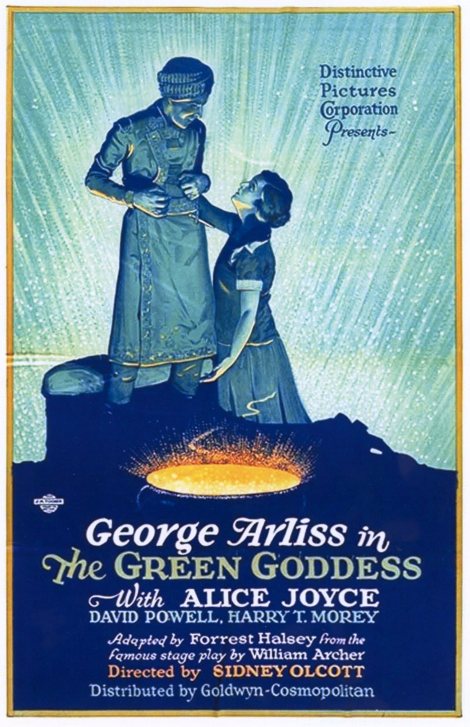
The seething East, hostages, civil unrest, despotic rulers, hatred of the West, reprisal killings – sounds like today’s news. In fact, these are plot elements from THE GREEN GODDESS, a hit play for George Arliss in 1921, that he made as a silent film in 1923, and again as a sound film in 1929. So how can something so old be so topical in the 21st Century?

The play was a first-time effort by veteran drama critic William Archer, based on a dream he had. Archer earlier published a book that set down rules for playwrights whereby he all but guaranteed that following his rules would assure success. Archer then ignored all his own rules in writing THE GREEN GODDESS.

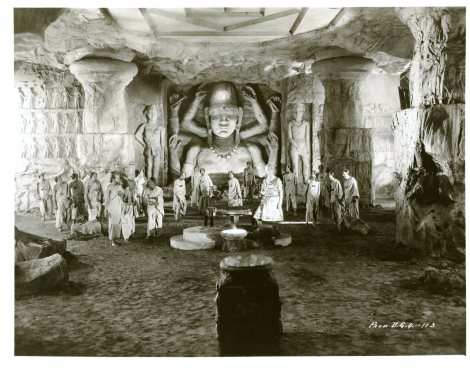
The temple of the Green Goddess but the play’s title actually refers to another type of green-jealousy. This is the set from the 1923 silent version.

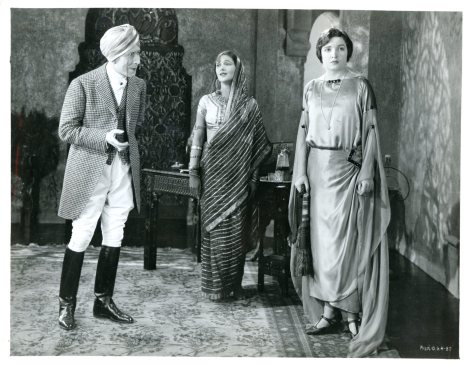
Arliss plays the omnipotent Rajah of Rukh, a small kingdom somewhere in the Himalayas. Western educated, but hateful of the British, the Rajah finds himself unexpectedly the host of three British survivors of a plane crash.

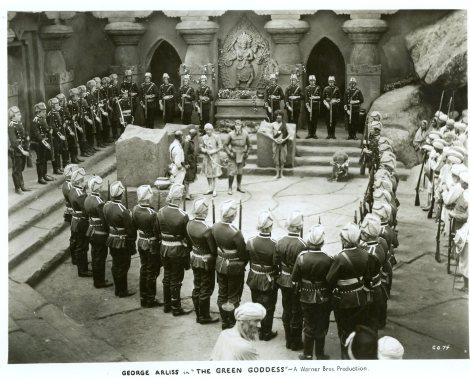
The Rajah impresses his guests with his militia.

Ever the perfect host, the Rajah gradually explains that he is holding the trio as hostages. His brothers have assassinated a British official and are due to be executed – so “an eye for an eye.”

The three “guests” – Major Crespin, his wife Lucilla, and Dr. Traherne – keep their wits, bribe the Rajah’s English valet, and attempt to send a wireless call for help.


Major Crespin is fatally shot by the Rajah and confesses that he failed to send the radio message for help. Arliss, Harry T. Morey, and Alice Joyce in the 1923 silent version.

But the Rajah is willing to spare Lucilla – if she becomes one of his wives. The silent version with Jetta Goudal as a lady in waiting.


To sweeten his offer, the Rajah proposes to kidnap Lucilla’s children and bring them to her in Rukh. Arliss and Alice Joyce again, but from the 1929 talkie version.

The Rajah’s ultimatum-return to the palace as his wife or be dragged back as his slave:

The sacrifice proceeds as planned with the two surviving guests, Lucilla and Dr. Traherne – –

Arliss, Alice Joyce, and Ralph Forbes in the talkie version.

— but the Major lied – his message did get through and the RAF arrives with bombs.

Now a deposed despot, the Rajah consoles himself over losing Lucilla with the classic closing line: “She’d
probably have been a damned nuisance.”

A lucky playgoer of 1924 not only preserved the ticket stub, but got Mr. A to autograph the playbill:

Notice the ad in the lower left of the playbill for the book edition- here’s the cover:

Finally, a rarity – the last page of the silent film script. Notice that Arliss’s exit line is faithfully preserved:

[Click on this image to access “hidden” frame captures from the 1929 film]

Notes: George Arliss was nominated for the Best Actor Academy Award both for THE GREEN GODDESS and for DISRAELI. He won for DISRAELI, thereby becoming the only actor in film history to compete against himself for the Oscar. Also, THE GREEN GODDESS was actually filmed prior to DISRAELI during the summer of 1929 but was not released until February 1930, some four months after DISRAELI’s release. Why? That’s another story.

The King’s Vacation

February 11, 2011

With the abdication of Egypt’s Mubarak, and the popularity of THE KING’S SPEECH, the George Arliss film, THE KING’S VACATION (1933), seems suddenly topical. One of three films in the Warners Archive release of its 3-disc George Arliss Collection, this film manages to be a funny, sentimental, and poignant story and truly an “adult” film in the sense that younger folks won’t “get it.”  The film was based on an original story written specifically for Arliss by Ernest Pascal. Here’s a summary:


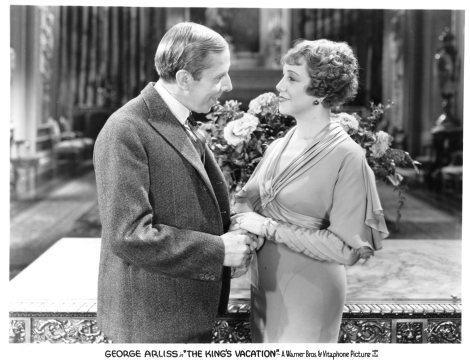
Arliss is King Phillip, and a reluctant king at that. Dudley Digges plays the Lord Chamberlain. In real life, Digges had been Arliss’s stage manager in earlier days before he turned to acting.


An assassination attempt convinces Phillip to abdicate. That’s O.P. Heggie as his valet. Arliss and Heggie last performed together in a World War I Bond fundraising play called OUT THERE in 1917.


Phillip tells his Queen Wilhelmina (Florence Arliss) that their arranged “marriage of state” is over and he is returning to his first wife. The Queen hints that she too has a lover that she calls only Mr.X.


Phillip and and his first wife Helen (Marjorie Gateson) are reunited. He meets his grown daughter (Patricia Ellis – Dick Powell is her boyfriend) and hopes to pick up where they left off 20 years ago.


Helen yearns for the palaces she never had and wants a tiara for her birthday gift from Phillip.

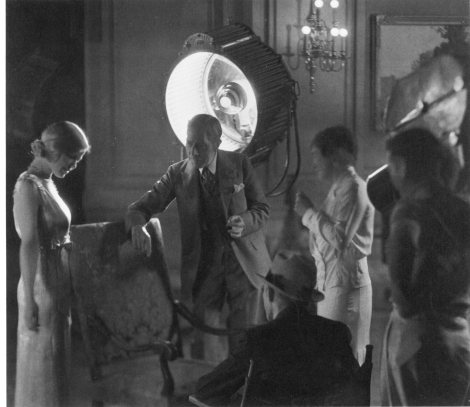
We interrupt this story to bring you a production shot. Arliss confers with the wardrobe mistress while an assistant director (seated back to camera) awaits the outcome:


On a shopping trip to the city, Phillip runs into his ex-Queen Wilhelmina. She invites him to tea.


Phillip and Helen come to realize that life has changed them in different ways and they are not the same people they were 20 years ago.

Another production shot. Actress Maude Leslie as the maid stands at left for her cue:

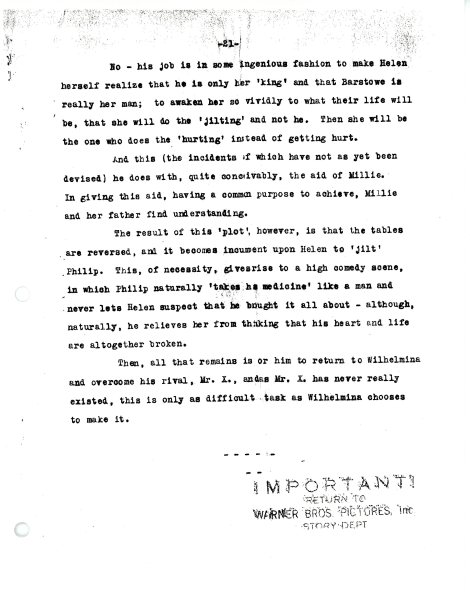
So how is this impasse resolved? Even author Ernest Pascal couldn’t figure that out. Here’s the conclusion of his story outline:

A lot of help he was –  but Arliss figured out the ending and it’s a good one.

Finally, a bit of newspaper publicity never hurt a movie:

Published in: on February 9, 2011 at 11:03 PM  Comments (1)