I recently came across this delightful interview with Mr. A published in the October 1908 issue of THEATRE MAGAZINE. I believe this may be the first interview he ever gave to any publication. I say this because up until that time he was a supporting actor and such players rarely had opportunities to be interviewed. He was all of 40 years old at this point and we can truly say that the interview captures him as an energetic young man embarking on what he could only hope was a new phase of his career.
George Arliss quotes Benjamin Disraeli – in AI
Mr. A regales us with a rare set of postcards published in conjunction with the play DISRAELI from 1911. This production became the first major hit of his career. In our video, Mr. A then resumes the character of Benjamin Disraeli to quote the lines.

Happy Birthday George Arliss – A 157th Year Anniversary 1868-2025
For this year’s observance, we are doing things a bit differently than in the past. We are literally presenting a George Arliss performance that nobody has ever seen. At least, nobody living today. I am referring to Mr. A’s appearance as Shylock in Shakespeare’s The Merchant of Venice.
He played it thanks to the wife of his producer, Winthrop Ames. It seems they had a wedding anniversary coming up and Mr. Ames asked Mrs. Ames to choose between one of two gifts. The first was a string of valuable pearls. The second was a theater production of The Merchant of Venice. Mrs. Ames chose the play and to nobody’s surprise Mr. Ames selected George Arliss to portray Shylock.
The play toured the United States throughout 1928 and apparently into 1929. This would prove to be Mr. A’s final appearance on the stage. When he toured with Merchant in Los Angeles, he was approached by Jack Warner and Darryl Zanuck of the Warner Bros. motion picture studio to star in their new fangled talking pictures. The idea was to film some of his hit plays. Alas, while Mr. A would go on to film a number of his popular plays, The Merchant of Venice was not among them.
Aside from several splendid photographs, there is no recording, visual or audio, of George Arliss as Shylock. But thanks to the advent of AI (Artificial Intelligence) we can now see and hear Mr. A in full costume and makeup reciting Shylock’s famous Act III soliloquy. I’d call this a very special Treat for this year’s April 10th Birthday Observance.
Season’s Greetings! George Arliss reads “The Night Before Christmas” by Clement C. Moore in AI
I’ll remember 2024 as the year where I learned how to use AI software. This includes animating photos, voice cloning, and writing “text-to-speech” material for my favorite subjects. The fruits of my labors have been posted here and elsewhere on the ‘net depending on the subject matter. My efforts also pressed me to upgrade my knowledge of colorizing images that I have slowly become competent with over the past several years.
Without further ado, here is a sort of Christmas present to our many Arliss fans who have stopped by over this year to learn what is new with Mr. A. I hope you enjoy this turn at reading poetry. And best wishes for the New Year!
Looking ahead I find myself wondering what’s next? We know that Mr. A did well in Shakespeare’s “The Merchant of Venice” playing Shylock. But he never repeated the character in films or on radio. Might AI enable us to have his Shylock recite one of the memorable speeches from the text. Imagine what may lay ahead for us in 2025!
George Arliss “speaks” about Acting in Silent Films
The “voice” is an AI generated clone copied from a recording of Mr. Arliss’s actual voice.
GA discusses the differences between acting in the theater and acting before the camera in silent films. The text has been adapted from an interview that GA gave titled, “Stars of Two Orbits” from the January 1922 issue of Filmplay Journal.
A Pilgrimage to the George Arliss Grave
This year we are celebrating Mr. A’s birthday anniversary today (April 10, 1868) in a more significant way. Recently, Tim Beech, a fellow Arlissian (my term, not Tim’s) made a wonderful visit to Mr. A’s gravesite at Harrow Weald Cemetery outside of London. He was representing in a very real sense all of us who have longed to visit the site ourselves and I must say we were well represented. Rather than me blather on, here is Tim’s first-hand account of his pilgrimage.
A Visit to the George Arliss Grave by Tim Beech
I had cause recently to take my wife to London’s Heathrow Airport for a Transatlantic crossing. It’s a journey taken countless times by George and Florence Arliss, though of course by steamship rather than by Boeing.
It also occurred to me that, while Heathrow is more than 140 miles from our home in the Midlands, it’s a distance of only around 10 miles from Harrow Weald. It was there that George and Florence were buried in 1946 and 1950 respectively and, thanks to the sterling efforts of Bob Fells, their previously neglected grave had been restored a few years ago.
This seemed too good an opportunity to miss.
I had never visited the site and was a little anxious I might struggle to find the right spot. Harrow Weald is a very large cemetery next to All Saints Church, a mid-nineteenth century structure where Mr and Mrs A were married on September 16, 1899. As GA noted: “We were married in the prettiest church on the prettiest day that ever was seen.” They now lie only a few yards from where they exchanged vows almost 125 years ago.

To make sure I didn’t make the pilgrimage in vain I did an extraordinary amount of preparation. I viewed the approaching roads on Google Street View, worked out where I might park, examined the layout via Google Earth, looked at pictures of the gravesite (it is next to a hedge) and checked in with Bob Fells, who gave me further instructions supplied by GA’s great grandnephew. Armed with such a volume and quality of information I felt confident as I passed the church entrance on the left and then turned into the cemetery off the Uxbridge Road.

I had dropped my wife at Heathrow before 6 but the cemetery was closed until 9am, so I spent the intervening time making the trip from the Airport (which takes around 45 minutes, despite the relatively short distance), having a quick breakfast at a café and exercising our dog Chase at a local park. Perhaps it was the time I’d spent waiting, or perhaps it was the amount of planning, but I felt a sudden unexpected sense of nervousness as I drove into the cemetery itself.
It wasn’t as if I were there to meet anyone. But it felt that way. Someone I had seen repeatedly on screen, read a great deal about and was now about to “encounter” in a sense. I also admit that I felt a responsibility to represent Bob Fells, who has done so much to preserve GA’s memory but has never had the chance to visit the gravesite. He had asked me to lay a rose on his behalf as well as take some pictures, and I had a few thoughts already in my mind.


There is also something deeply personal about visiting the gravesite – the fact it is so little visited makes it more special, and it’s therefore a very different experience in a way that visiting the graves of many other famous people is not.
So there was certainly some nervousness, and a degree of anticipation.
As I drove the very short distance from the Uxbridge Road the cemetery opened out into a wider expanse, with the church mostly hidden to the left. I saw a semi-circular addition to the driveway, which is really only wide enough for a single car, so I turned 180 degrees and parked.
I knew the gravesite must be to my right and not far from the church, but I couldn’t drive any closer to it. The route to the site is via a path clearly intended for pedestrians only. But even from a distance I was confident that I could see the grave around 100 yards away at around “2 o’clock” to my right, and took a couple of initial pictures.
I made my way over towards the grave, which is very close to a hedge that forms the boundary for this part of the cemetery. It was around 25 feet or so off the path to the left and, although it was a beautiful sunny morning, it was October in England and the fairly thick grass was damp under my feet. It was also in shadow, because the hedge runs north-west to south-east, and shielded the site from the morning sun.
I had brought with me some towels and cleaning detergent in the expectation that the grave might need some sprucing up, but it was in very good condition – I later learned from Bob that it is, for the moment, still under a maintenance contract. There was a small scattering of fallen leaves over the grave itself, but it was otherwise clear. However, stepping past the gravestone my toe-end caught the edge of a plastic bottle which went skittering across the grass. It turned out to be a whisky bottle and was accompanied by a few plastic bags lying randomly in the morning dew. Although the cemetery is well maintained and not at all overgrown it seems likely that it may be an attractive and secluded spot for off-hours visitors.

I returned from the car with a large cardboard box I had brought for the purpose of elevating the camera to take pictures; my iPad on which I intended to display some appropriate images; two books (Bob’s biography of GA and GA’s first autobiography); a bucket of water containing some roses I had clipped from our garden at home the night before; a pair of secateurs to trim the stems; and some silver foil in which to wrap them. I also found an abandoned vase lying on its side next to the hedge which I used to display the roses when I left.

The site is sufficiently far from the Uxbridge Road for most of the sound of the traffic to be muffled. There is a real sense of peace in the location – I could mostly only hear the sound of birds signing and a slight rustle in the hedge from an occasional breeze. There were no other people in sight in this corner of the cemetery, although a workman later arrived and started trimming the grass at the farthest distance opposite. Even though he was perhaps 400 yards or more away, the sound of his machine cut through the air because there was little else with which it had to compete.
I took around five dozen photographs and videos from every angle I could think of, although it was a little difficult at times because of the sunlight. I captured images with the books; with the photograph Bob had digitally made alongside GA; with the roses; and I also played an extract from the House of Rothschild. It’s the sequence where GA, playing Nathan Rothschild, is excluded from a Government bond issue on the grounds that he is Jewish, but then executes a plan to run the market down by selling bonds that force the financiers to pass the entire issue over to him.

It was quite emotional to watch the sequence, hear the voices of Mr and Mrs Arliss, and at that time be at the very spot where they now lie. It was a moment when I felt particularly connected with them, even though both had passed away almost two decades before I was born.
I trimmed the rose stems, wrapped them in silver foil and left them in the vase below the gravestone. I checked I had the photos stored and then took a few more for good measure as I returned to my car. The last view I had as I passed the hedge to my right was the gravestone, standing bright and tall despite the shade, and feeling I’d done everything I came to do.
Even the weather had been perfect. It was a pilgrimage completed.
**************
Thanks very much Tim for the time and effort you put into your visit. I have read of instances where biographers at times sense a personal presence of the individual they are chronicling. I once asked a well-known biographer privately if she ever had such an incident. We were at a ‘meet and greet’ and she told me she was glad I didn’t ask this during the Q&A session. She said she indeed had such experiences but didn’t want to admit that publicly. So perhaps this photo I constructed below may not be all that far-fetched.

I don’t know how I can sufficiently thank Tim Beech for making this visit but perhaps in a small (and corny) way I thought I’d use my dubious photoshop skills to create this little token of my appreciation:

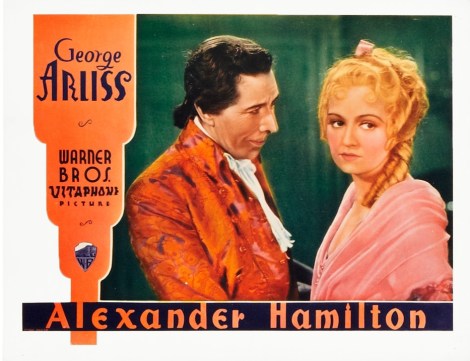
Arliss Alert! April TCM (US) Screenings: DISRAELI (1929) April 1 at 8:30AM EDT and ALEXANDER HAMILTON (1931) April 7 at 4:15 PM EDT
Check your listings to watch these two George Arliss Classics during the first week of April.
On April 1st is GA’s Best Actor Academy Award winning film, DISRAELI . An early talkie filmed during the stifling summer of 1929, and based on GA’s amazing 5-year theater run of the play, DISRAELI is told through a delightful series of intimate conversations that lead to a spellbinding climax.
The plot involves the British prime minister’s efforts to purchase the Suez Canal from Egypt before Russia can get its hands on it. This sounds, well, esoteric, doesn’t it? But therein lies the power of this film (and why the play ran for five years, plus two revivals, a 1921 silent film version, and also a 1938 radio adaptation that was heard live around the world).
Tune in on April 1st to discover what all the excitement was about.

Next on Friday, April 7 at 4:15 PM EDT is the “first version” of the recent hit Broadway musical, HAMILTON. GA co-wrote the play – no musical numbers in this version – that tells the story of the first Secretary of the Treasury’s extramarital affair. When this film was made in the Spring of 1931 it was decided to rename it ALEXANDER HAMILTION, perhaps to avoid confusion with the British Lord Hamilton and his extramarital affair. Is this movie dry stuff? We think not. Check it out yourself.
It’s Here At Last! The Official 2023 George Arliss Calendar
Want a copy? Just download and print. Legal-sized paper will provide the best results.

George Arliss – The Hidden Years: Letters from World War II
I am pleased to announce the publication of our new book. This is an entirely new work of research where we can now share Mr. A’s daily accounts of living in World War II London through his letters that he wrote to friends. These letters have never been published before and offer a personal account of his daily life that at times are amusing and sometimes sad. In addition to sheltering from the nightly bombing attacks by the German Luftwaffe, Mr. A also was the caregiver to his wife, Florence, who had lost her eyesight and was coping with a variety of other ailments.

Arliss decided to spend the war years in London, literally Ground-Zero for German bombers, when he could have joined his friends in sunny California. If he regretted this decision, he never even hinted at this in his many letters. His daily life included nightly aerial assaults from Nazi planes, V-1 and V-2 rockets flying over his home. Throughout these bombardments, Arliss maintained a lively correspondence with his American friends who were safely located in the states, as well as British friends who were safely out of harms’ way in other parts of Britain.
Mr. A had written two volumes of memoirs, the second being published just as the war broke out. Far from being antique writings that reflect a bygone age, this new work is a third volume of his memoirs that vividly describe perhaps the worst time in his life. The George Arliss wartime letters vividly echo the 21st century trauma endured by the COVID lockdowns and the devastation of the Russo-Ukraine War. The book is extensively illustrated with rare photographs, maps of the London bombing attacks, and appendices documenting his stage and film work.
This book is available in three formats: hardcover, paperback, and Kindle ebook, all through Amazon. Members of Kindle Unlimited can read the book for free. https://www.amazon.com/George-Arliss-Hidden-Years-Letters/dp/B0BGFHRBD3/ref=sr_1_2?crid=7FV15STWNYIW&keywords=george+arliss+letters&qid=1670003077&s=books&sprefix=Arliss%2Cstripbooks%2C97&sr=1-2
Excerpts from the Kirkus review: “… (Arliss) was, as Fells observes, a ‘prolific letter writer,’ one who managed, no matter who the correspondent was, to combine great generosity and candor with a lighthearted wit. The author collects here a trove of
communications that date from 1909 to 1945, the year before Arliss’ death, the most intriguing of which were written in
England during World War II. With astonishing composure, Arliss relates the ‘harrowing times’ he lived through, especially
the daily air raids mercilessly waged by German fighter planes, a dangerous threat that made the ‘blackness of the night
rather terrifying.’ Moreover, in addition to the perils and deprivations the war delivered, Arliss had to contend with an ill wife
who was losing her sight: ‘My life is violently changed from the days that were all too short for my liking. Now, I am with Flo
all day and every day; in addition to her nervous condition, her eyes are so bad that they do not allow her to either read or
write; so we are cut off from the theatre and the cinema; it is more than a year since I visited either.’ Fells supplies readers
with astutely informative commentaries regarding the circumstances of each letter, including Arliss’ interlocutor, and
adorns the book with marvelous pictures of the artist, his friends, and various miscellany like playbills….”
Happy Birthday, Mr. A – April 10, 2022, marks his 154th Birthday!
Actor, author, playwright, and filmmaker George Arliss was born in the Bloomsbury section of London on Good Friday, April 10, 1868. He made his professional stage debut in 1887, a time when theaters were lit by gaslight. Crossing the Atlantic in 1901 as a member of the Mrs. Patrick Campbell Company, George and his wife Florence eventually established themselves in the U.S. theater world. What was planned as six months stay turned into 20 years. Turning 60 in 1928, retirement seemed to be calling Mr. A, but so were talking pictures. Thus, he suddenly embarked on ten years in the studios (a phrase he used for the title of his second volume of memoirs) winning the Academy Award for Best Actor in the process. Today, at least seven of his films can be viewed on DVD and streaming video.
 ARLISS ARCHIVES
You must be logged in to post a comment.