I recently came across this delightful interview with Mr. A published in the October 1908 issue of THEATRE MAGAZINE. I believe this may be the first interview he ever gave to any publication. I say this because up until that time he was a supporting actor and such players rarely had opportunities to be interviewed. He was all of 40 years old at this point and we can truly say that the interview captures him as an energetic young man embarking on what he could only hope was a new phase of his career.
George Arliss quotes Benjamin Disraeli – in AI
Mr. A regales us with a rare set of postcards published in conjunction with the play DISRAELI from 1911. This production became the first major hit of his career. In our video, Mr. A then resumes the character of Benjamin Disraeli to quote the lines.

Happy Birthday George Arliss – A 157th Year Anniversary 1868-2025
For this year’s observance, we are doing things a bit differently than in the past. We are literally presenting a George Arliss performance that nobody has ever seen. At least, nobody living today. I am referring to Mr. A’s appearance as Shylock in Shakespeare’s The Merchant of Venice.
He played it thanks to the wife of his producer, Winthrop Ames. It seems they had a wedding anniversary coming up and Mr. Ames asked Mrs. Ames to choose between one of two gifts. The first was a string of valuable pearls. The second was a theater production of The Merchant of Venice. Mrs. Ames chose the play and to nobody’s surprise Mr. Ames selected George Arliss to portray Shylock.
The play toured the United States throughout 1928 and apparently into 1929. This would prove to be Mr. A’s final appearance on the stage. When he toured with Merchant in Los Angeles, he was approached by Jack Warner and Darryl Zanuck of the Warner Bros. motion picture studio to star in their new fangled talking pictures. The idea was to film some of his hit plays. Alas, while Mr. A would go on to film a number of his popular plays, The Merchant of Venice was not among them.
Aside from several splendid photographs, there is no recording, visual or audio, of George Arliss as Shylock. But thanks to the advent of AI (Artificial Intelligence) we can now see and hear Mr. A in full costume and makeup reciting Shylock’s famous Act III soliloquy. I’d call this a very special Treat for this year’s April 10th Birthday Observance.
Season’s Greetings! George Arliss reads “The Night Before Christmas” by Clement C. Moore in AI
I’ll remember 2024 as the year where I learned how to use AI software. This includes animating photos, voice cloning, and writing “text-to-speech” material for my favorite subjects. The fruits of my labors have been posted here and elsewhere on the ‘net depending on the subject matter. My efforts also pressed me to upgrade my knowledge of colorizing images that I have slowly become competent with over the past several years.
Without further ado, here is a sort of Christmas present to our many Arliss fans who have stopped by over this year to learn what is new with Mr. A. I hope you enjoy this turn at reading poetry. And best wishes for the New Year!
Looking ahead I find myself wondering what’s next? We know that Mr. A did well in Shakespeare’s “The Merchant of Venice” playing Shylock. But he never repeated the character in films or on radio. Might AI enable us to have his Shylock recite one of the memorable speeches from the text. Imagine what may lay ahead for us in 2025!
A Brief Word from George Arliss
This wonderfully detailed bust of Mr. A in his role as the Rajah of Rukh from THE GREEN GODDESS inspired me to try an AI program to animate it. Then, it was just a matter to synchronize the bust’s “movements” to an audio track that I created by cloning Mr. A’s voice from a soundtrack recording. Ah, but what might he say under these circumstances? Perhaps something about his role in the play, I thought?
George Arliss “speaks” about Acting in Silent Films
The “voice” is an AI generated clone copied from a recording of Mr. Arliss’s actual voice.
GA discusses the differences between acting in the theater and acting before the camera in silent films. The text has been adapted from an interview that GA gave titled, “Stars of Two Orbits” from the January 1922 issue of Filmplay Journal.
George Arliss “speaks” about his first film, THE DEVIL (1921), and the Future of Motion Pictures
Through magic of voice cloning we can hear Mr. A tell us about his very first film, THE DEVIL, and his thoughts on the future of motion pictures. To produce his voice, we used an Artificial Intelligence (AI) program that cloned an actual recording track of Mr. A’s voice. The text of his conversation is likewise authentic. It is taken from direct quotes of a magazine interview he gave to Shadowland magazine that appeared in its January 1921 issue. Your comments are welcome!
A Selection of World War II Letters by George Arliss: 1942 to 1943 – read by George Arliss (an AI voice clone using the actual voice of George Arliss)
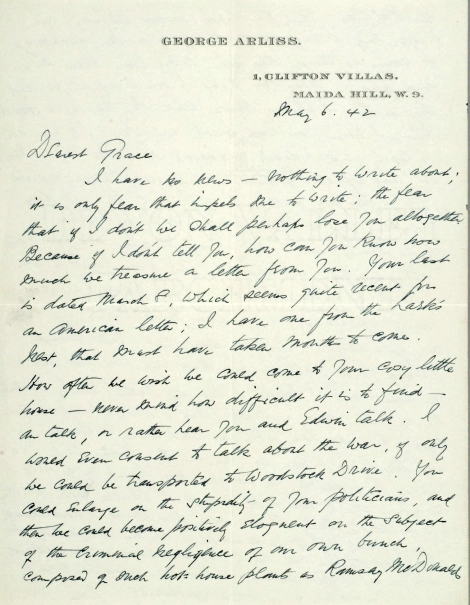
GA becomes nostalgic for the pre-war days and wonders if these will ever return. At the time he wrote this letter to Grace Hubble, wife of famed astronomer Edwin Hubble, the war was not going well for the Allies who were suffering serious setbacks in both the European and Pacific theaters:

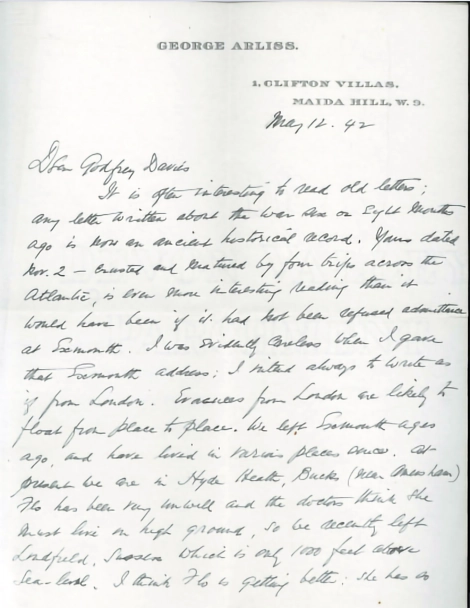
A few days later GA wrote this letter to historian Godfrey Davies who lived in California. The Arlisses are living away from London due to German bombing attacks and GA relates the poor state of Florence’s health, especially her eyesight.

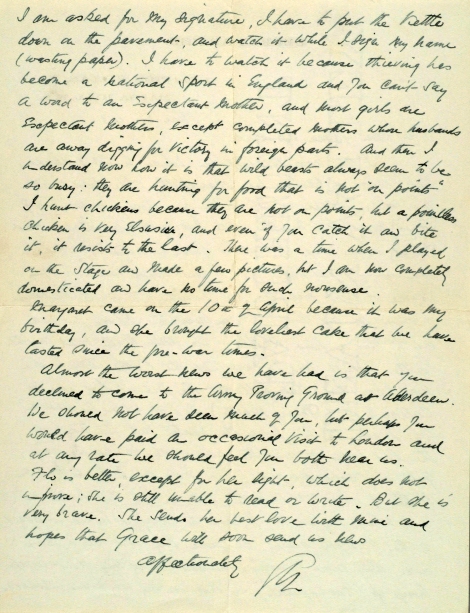
A month later GA writes again to the Hubbles and he’s more upbeat, joking to Edwin that Grace is treating him “shamefully.” Noting his appreciation for how busy Edwin must be, GA relates that he too is busy – trying to buy a new kettle. GA also comments of the “points system” involved in food rationing:

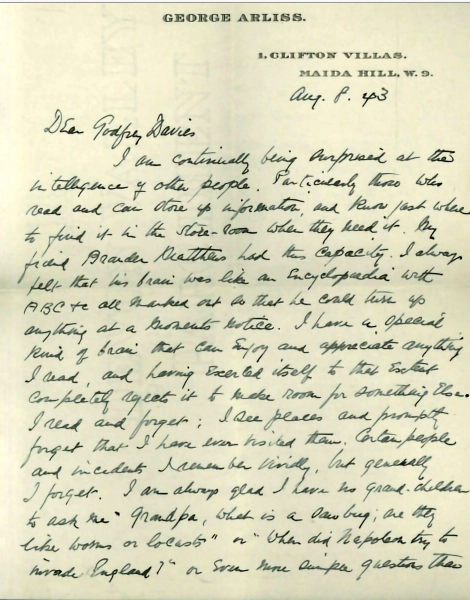
GA discusses his short term memory loss and how it is just as well that he doesn’t have any grandchildren because he would not be able to answer their questions. He closes by commenting on the war news and the defeats suffered by Germany:
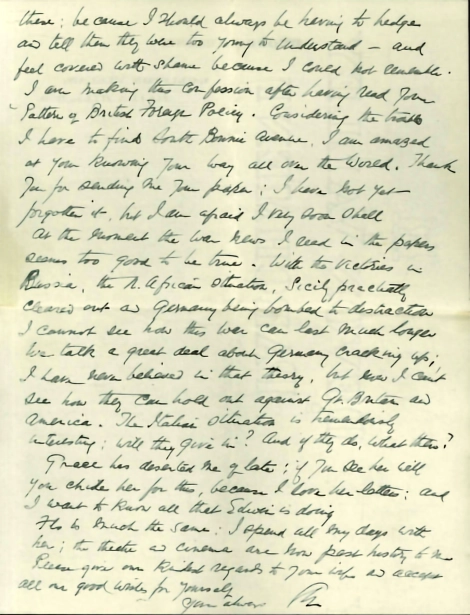
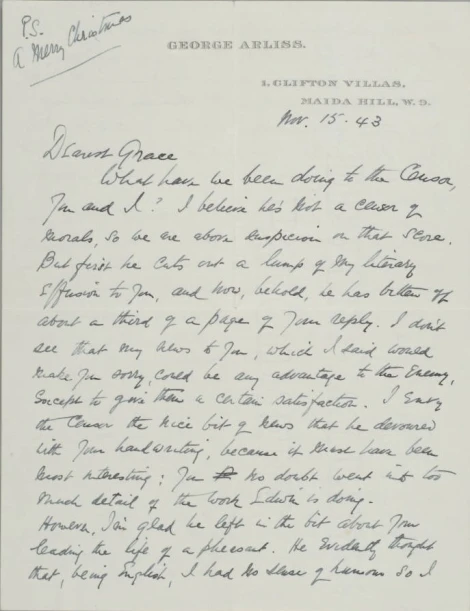
By November 1943, the war news was getting better and the common wisdom suggested that the war was certain to be over soon. GA notes how the postal censors interfere with people’s correspondence by literally cutting out parts of the writing that are judged too sensitive. He refers to news that would make Grace “sorry.” No doubt he was referring to the destruction of his cottage at St. Margaret’s Bay that was hit by a German shell the previous year.

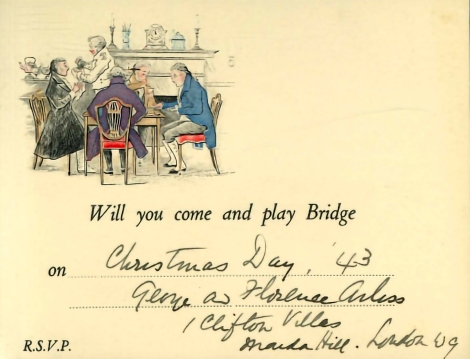
As 1943 was coming to end there was widespread optimism that the war would certainly end during 1944. Perhaps as a sign of the times, GA sent this playful invitation to Godfrey Davies, who was living in California, to drop by GA’s London home on Christmas Day to play some bridge:
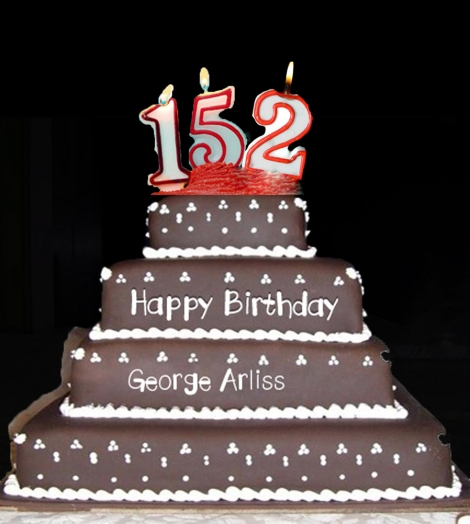
Happy 156th Birthday to George Arliss 1868 to 2024
On this day of April 10, we remember the birthday of George Arliss who was born during the Victorian Era (1837- 1901) and where he spent over thirty years of his life. When he made his theatrical debut in 1887 stage lighting was still by gaslight. Motion pictures were experimental with any commercial use not even dreamed of. Radio did not exist, nor did airplanes or telephones. This was the 19th century world where Mr. A grew up into his 30s and nobody, least of all himself, could have dreamed of the areas in the performing arts where he would conquer
Click on this video and enjoy:

 ARLISS ARCHIVES
You must be logged in to post a comment.