Arliss Archives Announces New Companion Site

The Arliss Archives is pleased to announce the establishment of a companion site called OLD HOLLYWOOD IN COLOR. Why? Please visit our new site for the details and to subscribe so you won’t miss a single post. http://OldHollywoodinColor.com

In the meantime, watch for our newest post on the Arliss Archives titled THE ARLISS STOCK COMPANY – PART ONE. Thanks.

Published in: on July 16, 2011 at 9:55 PM  Leave a Comment  

A Special Tribute for the Fourth Of July – Alexander Hamilton (1931)

The best playwrights in the United States offered new works to George Arliss after his five-year run in DISRAELI. After a few false starts, Mr. A settled on a fledgling effort written by a housewife in upstate New York named Mary Hamlin. She wrote extensively about her collaboration with Mr. A, both on the 1917 play, HAMILTON, and later the 1931 film version retitled ALEXANDER HAMILTON. This post will focus on the Warner Bros. film and Hamlin’s contemporary letters from Hollywood to her NY home, and her later memoirs.

Hamlin participated in story conferences that producer Darryl Zanuck ran roughshod over with his non-stop talk and his haywire ideas, most of which he forgot about. One idea stuck – to open the film with Gen. George Washington making his Farewell Address to his troops at the end of the Revolutionary War in 1783:

Alan Mowbray was hired to play Washington, his first of three Arliss films. Hamlin recalled that Mowbray refused to rehearse his part in front of Mr. A and performed only for filming.

The studio had planned to film Mr. A’s first starring success, THE DEVIL, from 1908. But he disliked the play by 1931 and Warners went scurrying for another vehicle. Zanuck was unaware of the HAMILTON play that Arliss had co-authored with Hamlin, but when he learned of it insisted that it be filmed. Mr. A felt he was much too old for the role but Zanuck waved aside his objection.
Here Washington tells Hamilton he wants to return to Mount Vernon to live out his days in peace, but Hamilton tells him he has other plans.

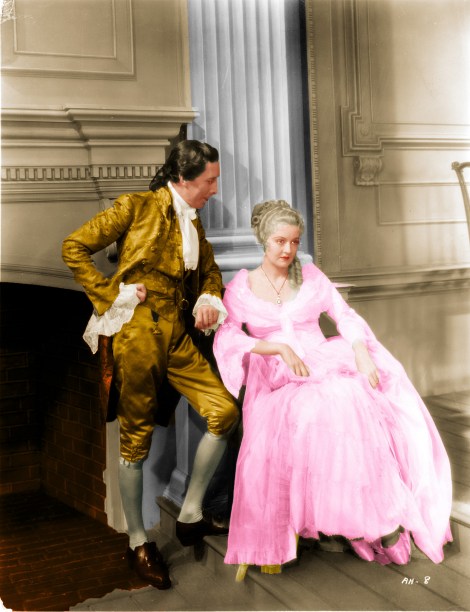
Eight years later in 1791, the temporary capital of the U.S. is located in Philadelphia; Washington is the first President and Hamilton is the first Secretary of the Treasury. He is also married to Betsy, played by silent screen star Doris Kenyon:
But Hamilton has determined political opponents in James Monroe (Morgan Wallace) and Thomas Jefferson (Montagu Love), who adamantly oppose Hamilton’s plan to establish a strong central banking system fearing it will encroach on the sovereignty of the states:
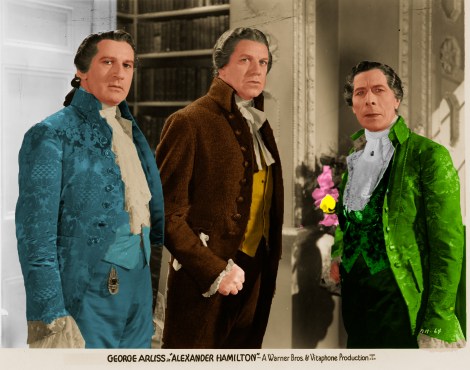
Although Monroe and Jefferson could hardly be portrayed as villains, Mr. A cleverly cast Wallace and Love, two well-known supporting actors who specialized in playing bad guys, in the roles to subliminally influence the audience’s perception of these characters.

Jefferson and Monroe need Hamilton’s support to locate the Capitol in the South, believing that he will champion his home state of New York. Senator Roberts (Dudley Digges), seated in the middle, has a personal grudge against Hamilton who refused to support his nomination for ambassador to France:

Monroe, Jefferson and Roberts confer with Hamilton about his “Assumption” bill whereby the federal government would assume the states’ obligations to pay the Revolutionary War veterans their pensions, and also about Jefferson’s “Residency” bill to establish the U.S. Capitol:
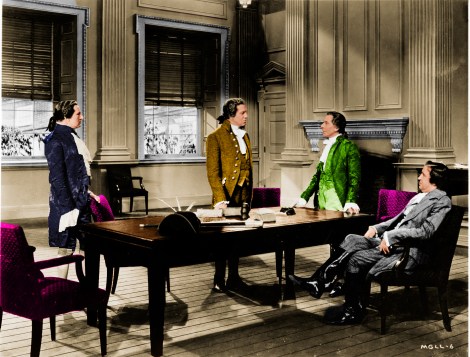
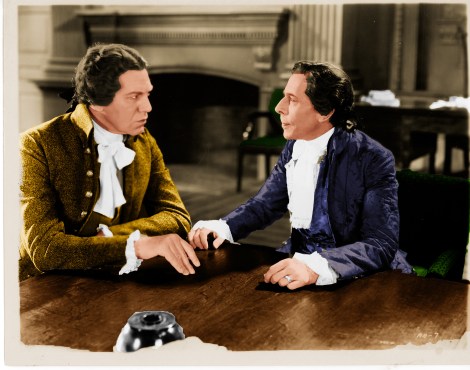
Jefferson knows that without Hamilton’s support, the Capitol will not be located in the South. They agree to a compromise – the Capitol will be located on the Potomac by northern Virginia, in return for Monroe and Jefferson’s support of Hamilton’s “Assumption” bill to create a federal banking system that will pay the veterans’ pensions:
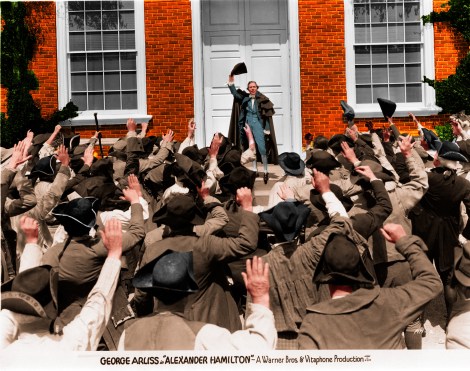
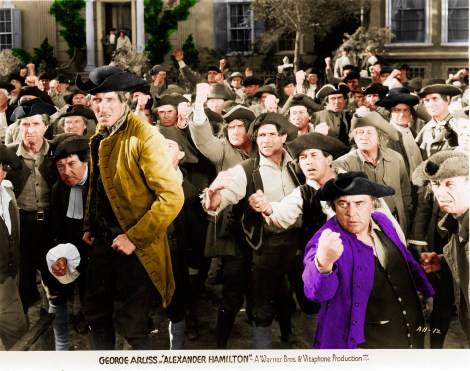
But Sen. Roberts incites a crowd against Hamilton, saying that he won’t help them. When Hamilton appears, one man throws a rock nearly hitting him:
Charles Middleton is the tall actor on the left who was apparently slated to play Chief Justice John Jay, but appeared only in this uncredited role.

Hamilton learns that his assailant was incited by Sen. Roberts. He also learns the man is a War veteran and jokes, “You must have been a sharpshooter because you nearly got me.” He orders the man released:
Hamlin said this unidentified actor had a wife who was dying in the hospital but he needed the job to pay the bills. Once his scene with Mr. A was completed, a studio car took him directly to the hospital.

The jeering crowd now has only cheers for Hamilton:
Betsy’s father, old Gen. Schuyler, arrives with news that her sister in England is seriously ill and is calling for her. Betsy sails for England leaving her beloved husband:
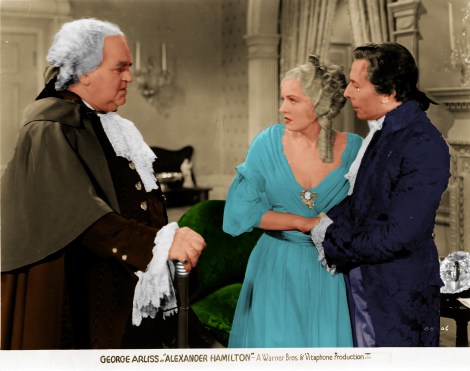
Veteran screen actor Lionel Belmore plays “old” Gen. Schuyler but Belmore was only a year older than Mr. A.

Ne’er-do-well Reynolds (Ralf Harolde) was fired by Hamilton from the Treasury for dishonesty. He is buying up the veterans “worthless” pensions for pennies on the dollar in the hope that the federal government will eventually redeem them at full value. Reynolds suggests to Sen. Roberts how Hamilton’s reputation can be destroyed and his political career ended:
Hamlin noted that Dudley Digges (Sen. Roberts) had directed the 1917 stage version of HAMILTON and also played the part of Reynolds on the stage.

Late one night during Betsy’s extended absence, a young woman (June Collyer) calls on Hamilton. She claims she is the widow of a War veteran and is impoverished. She asks if she can obtain a loan from the Treasury:

Hamilton takes pity on the lonely widow and makes her a personal loan. He walks her home but then…..
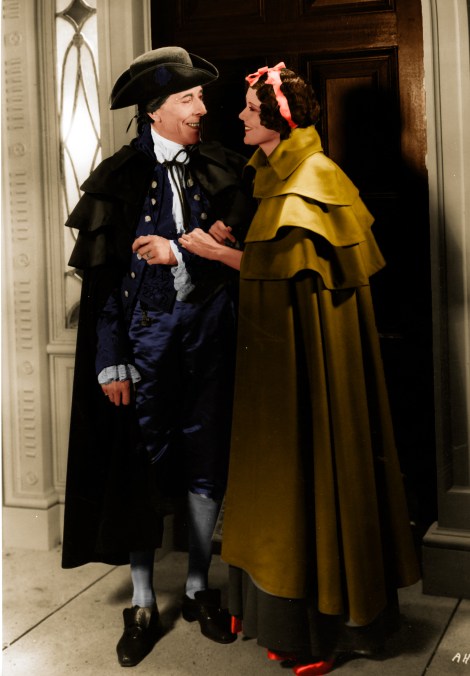
A reception is given to celebrate Betsy’s return home. Reynolds turns up as an uninvited guest to blackmail Hamilton – the lonely widow is in fact Reynolds’ wife!

Sen. Roberts springs the trap to ruin Hamilton – he claims that Hamilton made secret payments to Reynolds to act as his agent to buy up the veterans’ pensions knowing that when the Assumption bill passed Hamilton would enjoy a windfall:
Hamilton can defend himself only by explaining the real reason for paying Reynolds, as blackmail to hide his affair with Reynolds’ wife.

The conflicting stories become public and Hamilton faces the ruin of his marriage and of his career. But he and Betsy become reconciled to face an uncertain future:
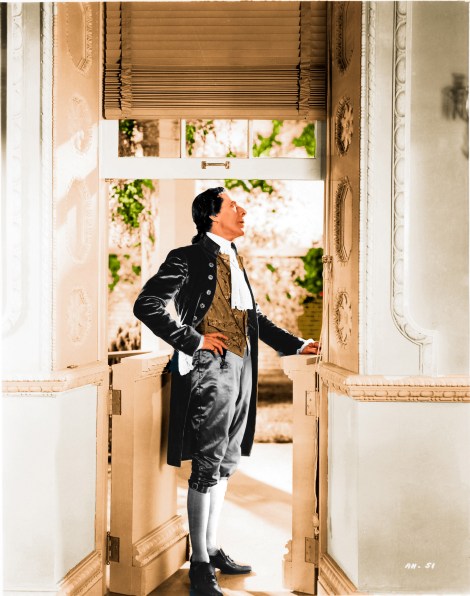
Jefferson, Monroe and the leaders of both political parties assemble to tell Hamilton, or so he fears, of his dismissal from the Government and the defeat of his Assumption bill:
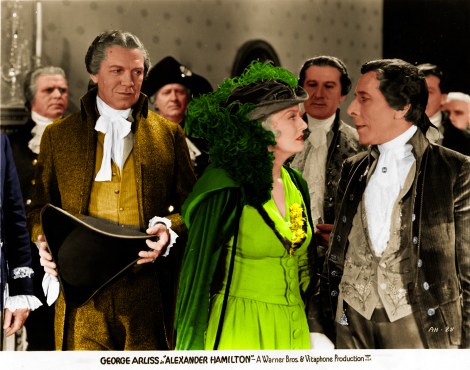
The meeting is interrupted by the arrival of President Washington who personally assures Hamilton of his confidence in him and the news that Congress has passed his Assumption bill.
Hamilton conveys his gratitude and observes that it doesn’t matter what happens to Alexander Hamilton the man. By passing the Assumption bill, Congress has established the credit of the United States and ensured the future prosperity of the nation. The End.

Production Photos:

Even outdoor filming does not interrupt Mr. A’s 4 pm tea break:
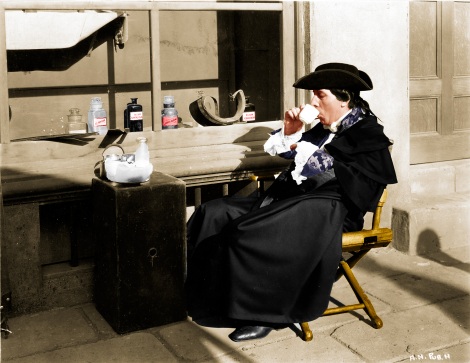
June Collyer and Mr. A had only one scene together, part of which was filmed outdoors at night. Here they seem to be standing by waiting for nightfall to film the scene:

Enlarging this photo shows that Mr. A is wearing his famous monocle, in other words he is posing as himself and not in character.

A rare photo with John Adolfi, director of seven of the ten Arliss Warner films. Mr. A shows Doris Kenyon and Adolfi a 200 year-old watch that he wears in the film:
Mary Hamlin was an expert on early American furniture and supervised the settings used and provided by W&L Sloane Co. Hamlin asked the Sloane manager how much Warner Bros. paid for the furniture and was told that it was being lent to the studio for free in return for a screen credit. When Hamlin asked why the company agreed to this arrangement for only one film, the manager said, “Because it’s a George Arliss film.”

Another rare photo of producer Darryl Zanuck with Mr. A on the set. Hamlin learned in time to share Mr. A’s high regard for Zanuck, that despite Zanuck’s verbosity he was something of a genius:

Hamlin and Mr. A corresponded until his death in 1946, and Hamlin later wrote that he was a gentleman in every sense of the word. He insisted that she be paid 75% of the royalties on the play even though he rewrote most of it. Her letters from the studio in 1931 give a fascinating glimpse of the work environment. She was surprised that John Barrymore looked so old and assumed he would no longer be playing leading man roles. She met Noah Beery, Sr., who appeared in the Arliss film, THE MILLIONAIRE (1931). Commenting on Mr. A, Beery said, “He’s such a nice man!” Hamlin’s writings confirm that George Arliss was the prime creative force in his films, but almost never taking credit for anything but his acting.

Winning New Friends-Alexander Hamilton (1931): Another Coming Attraction!

Somehow the caption, “Hamilton is the hero of the people,” doesn’t quite work with this photo. But with George Arliss in the the title role, find out how he turns those jeers into cheers. Film buffs will recognize veteran character actor Russell Simpson on the far left playing an old Revolutionary War veteran. To his right most prominently tall is Charles Middleton, a well-known supporting actor usually cast as villains (e.g., Emperor Ming the Merciless in Flash Gordon serials). Curiously, the cast log for HAMILTON lists Middleton as playing John Jay, the first Chief Justice of the U.S. Supreme Court, but this character never appears in the finished film and all we have of Mr. M is this uncredited bit (he’ll never get to the Supreme Court this way!):

CHECK BACK SOON for more Coming Attractions as our launch date of July 4th for ALEXANDER HAMILTON nears!

Published in: on June 19, 2011 at 5:21 PM  Leave a Comment  

More HAMILTON Coming Attractions!

Mr. A was understated, among many other things. In ALEXANDER HAMILTON (1931) his two great adversaries are Thomas Jefferson and James Monroe. Yet all three men number among our heroic Founding Fathers – so how can Mr. Tom and Mr. Jim possibly be villains? They certainly don’t DO anything villainous within the context of the film. The solution for Mr. A was as simple as it was ingenious – cast actors well-known for playing bad guys as Jefferson and Monroe. Movie audiences tend to bring their perceptions of actors in character with them from film to film, especially when the actor in question is almost always cast as the villain.

Here is typecast bad guy Morgan Wallace, as James Monroe, and super villain Montagu Love (he was killed off by the best including Rudolph Valentino and John Barrymore) as Thomas Jefferson. Mr. A as Hamilton probably would prefer to keep company with Aaron Burr:

Please check back here throughout June for more updates as our target date to launch – July 4th – nears!

Published in: on June 11, 2011 at 11:07 AM  Leave a Comment  

Alexander Hamilton – Just in Time for July 4th!

Mr. A’s co-author on his 1917 play, Alexander Hamilton, was Mary Hamlin. She came to Hollywood from her home in upstate New York to participate in the film version in 1931. Through her writings at the time and later on, Hamlin has given us an almost day-by-day account of the production, life at Warner Bros., and insights into many people there including John Barrymore, Noah Beery, Florence Arliss, and of course Mr. A himself. This post is requiring a lot of work and contains much information not in my book – so please keep an eye out for it. Lots of photos too, many never before published.
Hamilton and Washington – the original Dream Team

Check this space during June for an extended HAMILTON post to celebrate the 4th of July – Arliss Style!

Published in: on June 3, 2011 at 2:14 AM  Leave a Comment  

Relatively Speaking

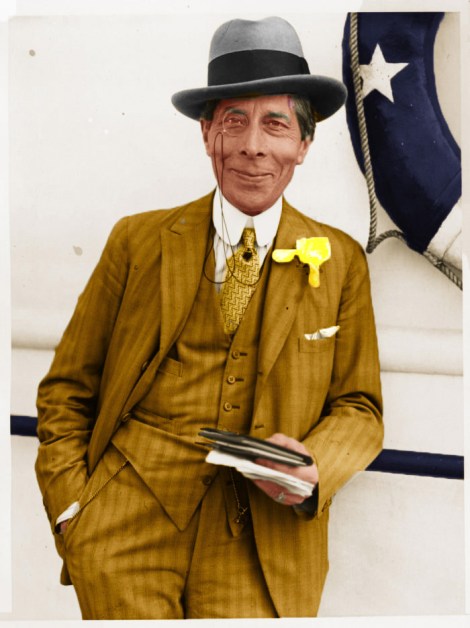
George Arliss had one of the longest commutes to work in history. He routinely traveled from his home in London, crossed the Atlantic by ocean liner to New York, then trained across the American continent to Los Angeles. The entire trip in those pre-jet travel days took close to two weeks. Not surprisingly, such journeys themselves became social rituals and people wore their best clothes for travel, not including formal attire for events shipboard. Here Mr. A is on the S.S. Majestic leaving New York on May 29, 1931, bound for Southampton, England. He has just completed filming ALEXANDER HAMILTON at Warner Bros. in Hollywood:

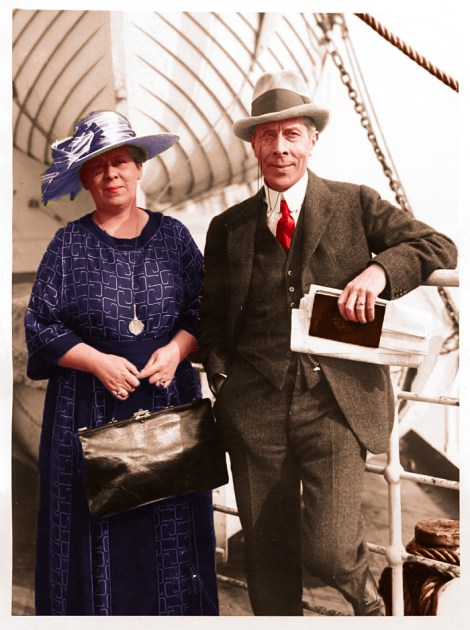
Mr. A’s best known relative was his wife, actress Florence Arliss. She accompanied him on his theatrical tours, then on his trips to make films in Hollywood. They wintered in America and returned to Britain in the spring each year. Aboard the S.S. Mauretania in September 1922, Mr. and Mrs. A arrive in New York for the start of the new theatrical season:

Mr. A’s journeys were considered newsworthy and his progress was duly reported. The caption to this news photo states, “Arliss Passes Through Chicago,” and is dated June 18, 1930:

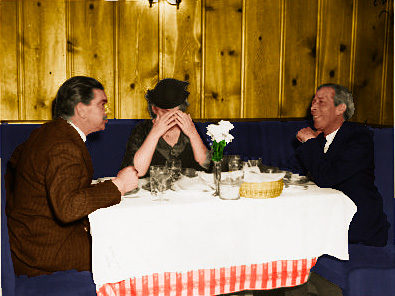
Celebrating the end of Prohibition with British actor Leslie Banks, the Arlisses visit the Vendome Cafe in Hollywood on November 7, 1933. The photo caption states, “Mr. Arliss is seldom photographed in the night spots of the film capital but Repeal brought him out.” Mrs. A appears less willing to be photographed:

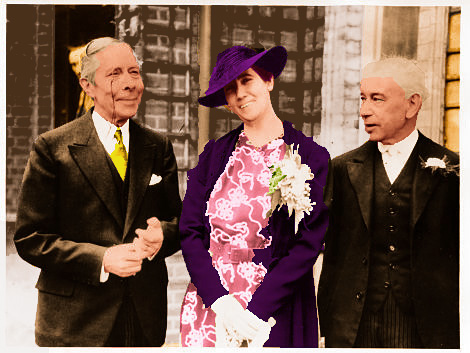
Believe it or not, George Arliss had an OLDER brother, Charlie. Here Mr. A serves as best man at his brother’s wedding to Miss Violet Moutrie on July 11, 1938. They are standing outside the Hammersmith Register Office where the marriage took place. The photo caption states that Mr. A is 70, and the former Miss Moutrie is 50, but declines to reveal Charlie’s age:

Warner Bros. colleagues of Mr. A made news with their relatives too. Here Al Jolson and his movie star wife Ruby Keeler attend a testimonial dinner for Eddie Cantor at the Ambassador Hotel in Los Angeles on October 28, 1937. The kibitzer in the middle is Joe E. Brown:
A radio broadcast of the evening’s speakers exist but neither Keeler, Jolson nor Brown performed that night.

Here are Al Jolson’s parents, the Cantor and Mrs. Jolson, in an undated photo, circa the 1920s. Al was born in Lithuania but the family emigrated to Washington, D.C. where he grew up. Cantor Jolson lived to be 95 and was active almost to the end of his life. His son frequently told humorous stories about his father on radio during the 1930s. Once the Cantor declined to attend one of Jolson’s shows because he would miss an Amos ‘n’ Andy broadcast:

Another Warners colleague, Edward G. Robinson, celebrates his son Manny turning 6 years old on March 18, 1939, with a gala cowboy party with the children of many Hollywood notables as guests. Mrs. Robinson is the cowgirl:

Relatives of Mr. Robinson attend the New York premiere of one of his films on September 19,1933. Left to right, Mr. R’s mother, Mrs. Sarah Goldberg, his brother, Oscar Goldberg, and EGR’s wife. Eddie himself was in Hollywood working on another film:

It seems that every Warners star had a relative nearby. Here Rin-Tin-Tin, Warners “bread and butter” star of the 1920s, poses with his mate, Nanette. They co-starred in several films together and Rinty sometimes had to choose between rescuing the film’s heroine or Nanette. He tended to choose the heroine but Nanette did fine fending for herself:

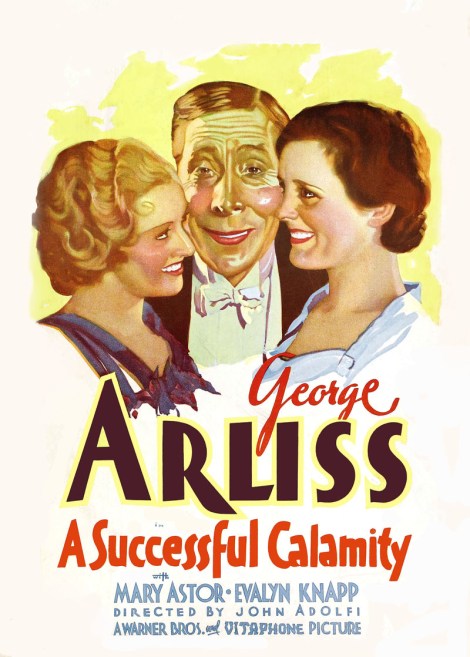
A Successful Calamity (1932)

One of the more obscure films in the Arliss Canon, A SUCCESSFUL CALAMITY is happily back in circulation from Warner Home Video as part of a three-disc dvd set, the George Arliss Signature Collection. Think of Mr. A in “Father Knows Best” and you’ll know what to expect. The film is based on a 1917 play written by Clare Kummer who specialized in feather-weight domestic comedies. The play gave a needed change of pace to William Gillette who had been playing Sherlock Holmes on the stage since 1899. Warner Bros. may have figured that if this play was good enough for “Sherlock Holmes,” it was good enough for “Disraeli.”

Mr. A plays international financier Henry Wilton who has just returned from a year abroad in the service of the President of the United States. Eager to return to his family, he arrives home a day ahead of schedule and finds only his butler, Connors, there to greet him. Wilton decides to visit his family members at their various appointments. His son Eddie (William Janney) is playing in a polo match:

Eddie is sidelined by his coach, Larry Rivers, played by Randolph Scott. The man in the derby is Grant Mitchell playing Connors:

Wilton’s daughter Peggy (Evalyn Knapp) is in love with Larry Rivers but engaged to a nerdish young man:

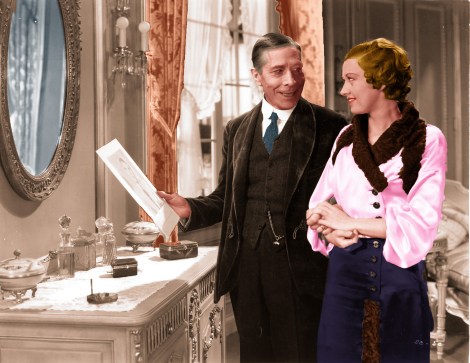
Emmie (Mary Astor) is Wilton’s wife by a second marriage. Earlier he observes that he was criticized by some for marrying a woman much younger than himself. He learns from Emmie that they are “patrons” of a handsome young pianist, Pietro, who is much closer in age to Emmie.

Wilton despairs of having a quiet evening at home with his family given their busy social lives. He wonders if the poor have the same problem, but Connors tells him no, because “the poor don’t get to go very often.” This gives Wilton an idea:

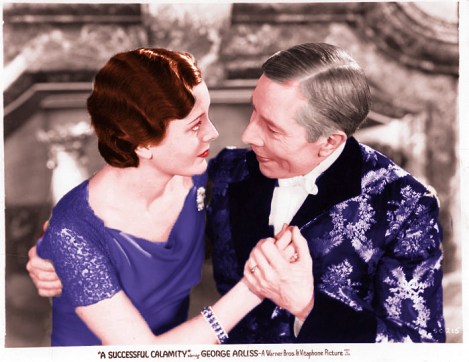
Wilton breaks the “news” to Emmie that they are “ruined” and must sell everything. She cancels her evening’s plans to stay home with him:

Wilton also informs Peggy and Eddie of their ruin and they likewise cancel their plans and find themselves enjoying a simple dinner with their dad and step-mother to plan their future:

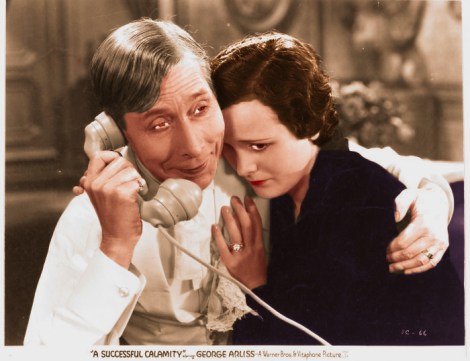
Before Wilton can tell Emmie the next day that he is not ruined after all, he learns that she has packed up all her jewelry and left in a taxi with her protege Pietro. Fearing the worst, Wilton tells Larry, Peggy and Eddie that Emmie left because she was afraid to be poor:

But Emmie has not left him, she only sold her jewelry to raise money and Pietro came along because he knows a good pawnbroker. Wilton’s family reflects on their brush with poverty by wondering why they were happier spending time at home. Wilton explains they were happy because “the poor don’t get to go very often.” The End.

Warners granted Mr. A a rare concession that was not even mentioned in his contract – the studio paid the cast (but not Mr. A) an extra two weeks salary so they could rehearse prior to any filming. The script for A SUCCESSFUL CALAMITY was then performed as play from beginning to end before an audience of studio workers including the director. The script was revised based on audience reaction and only when the script was finalized would filming begin.

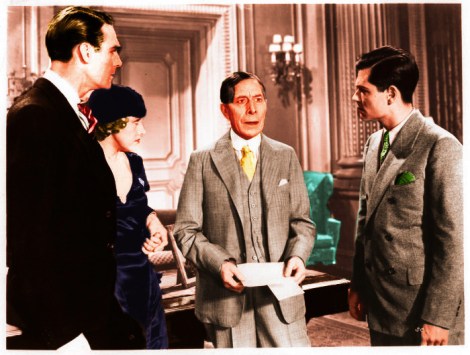
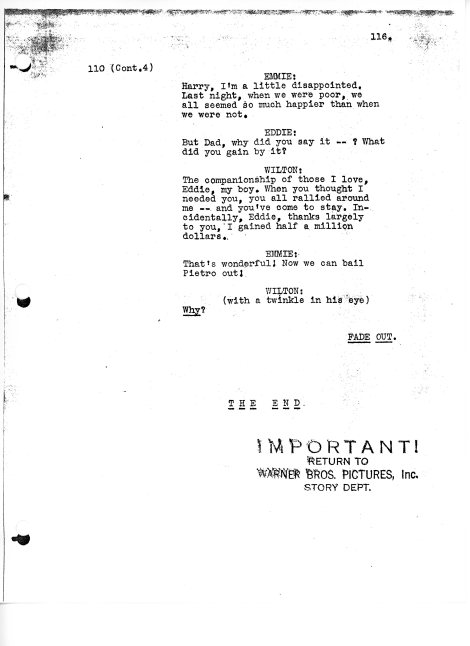
Yet refinements to the script continued even during filming. The story is simple enough but was filled with dangerous shoals for its characters. For example, Peggy and Eddie could easily have been played as spoiled brats but instead come across as likeable (but spoiled) youth. The same can be said of Emmie although Mary Astor brings an inherent intelligence to her character. Wilton’s claim of being ruined seems like a nasty trick and in the script he admits to his family that it was a cruel joke:

In the film Wilton never tells them it was a hoax and indeed it seems that they are better off not knowing. The hoax serves as a reality check making Eddie and Peggy realize that they have to support themselves instead of living off Dad. The viewer is left with the impression that they are better people thanks to the “cruel joke.” Thus, the ending dialogue was changed from the final script and the story is more effective as a result:

A SUCCESSFUL CALAMITY satirizes modern “futuristic” music and art deco design but is most surprising in its focus on the travails of the wealthy during the height of the Great Depression in 1932. Perhaps the public enjoyed being voyeurs among the rich while forgetting their more basic problems. In any event, the film was profitable for Warner Bros., as were all of the Arliss films, with gross revenue of $642,000 and netting a profit of $127,000, or 25 percent over costs. Not bad for a story as light as pixie dust.

The Doctor is In – Dr. Syn!

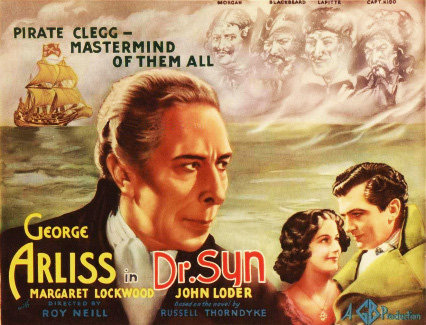
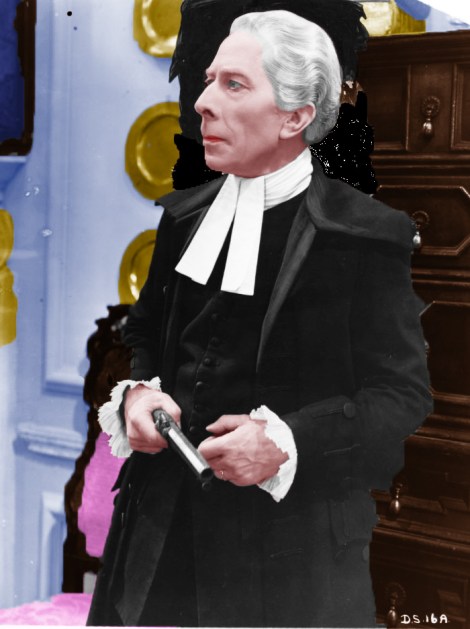
George Arliss as action hero? Not likely but Mr. A comes close with DR. SYN (1937), a corking good pirate yarn based on a popular novel by Russell Thorndyke. The novel is a thematic blend of Robert Louis Stevenson and Sigmund Freud that was so successful Thorndyke wrote several sequels. The novels still have quite a following in the UK. The story is set in Dymchurch, a seaside village in Kent, England, in the year 1800.

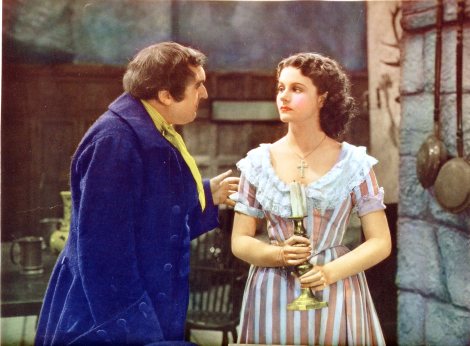
Mr. A plays the saintly vicar, Dr. Syn, who looks kindly on the blossoming romance between the orphan Imogene, played by Margaret Lockwood, and Denis Crabtree, son of the village squire, played by John Loder:

Dymchurch is plagued by nighttime apparitions of ghost riders on the nearby Romney Marsh but the main business of the villagers is a little fuzzy. Turns out the leading occupation is smuggling to avoid the exorbitant excise taxes imposed by the King. The ringleader is known only as “The Scarecrow.”

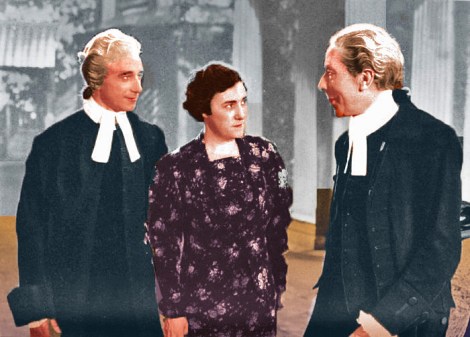
Dr. Syn becomes alarmed for his parishioners when a contingent of the King’s revenue patrol arrives at Dymchurch to investigate smuggling activities. Captain Collyer suspects that the nightly ghost riders are a cover for the smugglers and that Dr. Syn knows a lot more than he cares to tell:

Collyer learns that a number of the villagers were the crew of the notorious pirate, Captain Clegg, who was hanged twenty years earlier and lies buried in the churchyard cemetery – or does he? Dr. Syn alerts the sexton to spread the alarm:

Dymchurch schoolmaster Mr. Rash has designs on Imogene and tries to blackmail her with threats to reveal that she is the daughter of Captain Clegg:

As Capt. Collyer begins to close in, Dr. Syn realizes that he must take action to protect the village. Of course, not only is he “The Scarecrow,” he is Captain Clegg….

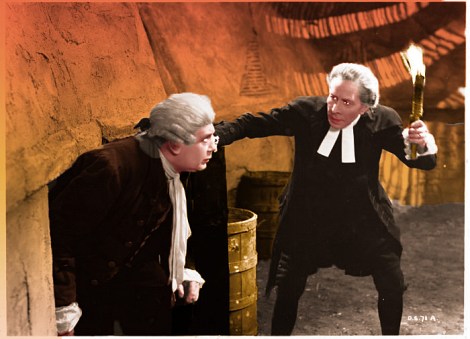
…and Imogene is his daughter. Mr. Rash must be silenced:

The discovery of Mr. Rash’s corpse results in the convening of an inquest where Capt. Collyer cross-examines Dr. Syn and forces him to admit his true identity. Before he can be arrested, the villagers intervene to foil Collyer’s men:

With Collyer’s men in hot pursuit, Dr. Syn stops by the church long enough to marry Denis and Imogene, then rejoins his old crew on their old ship, which was kept ready and hidden in a nearby cove, where they sail away for further adventures.

DR. SYN is technically George Arliss’ final film, but we at the Arliss Archives prefer to regard it as Mr. A’s most recent film. On the set, Alan Whittaker is Mr. A’s stand-in, Maude Howell serves as associate director, and Mr. A is in his 70th year:

Queen Mary attended the film’s London premiere, and the New York Times gave DR. SYN an enthusiastic review stating that it was better than MGM’s TREASURE ISLAND (1934). The film is widely considered the best of Mr. A’s five British films and is available on home video in an acceptable (but not restored) dvd edition through various outlets including Amazon.

Broadcasting to Millions

By the mid-1920s, the rising popularity of radio was cutting into movie theater attendance. While some film producers could only complain about it, the Warner Brothers acquired their own radio station, KFWB Los Angeles, and erected twin broadcasting towers to give it a powerful signal. Among other things, Warner film stars were expected to appear to build up public interest in their films. Young stars with limited stage experience were terrified to be performing “live” with millions of people listening. But veterans of the stage such as George Arliss who had performed “live” their entire careers were not intimidated by broadcasting.

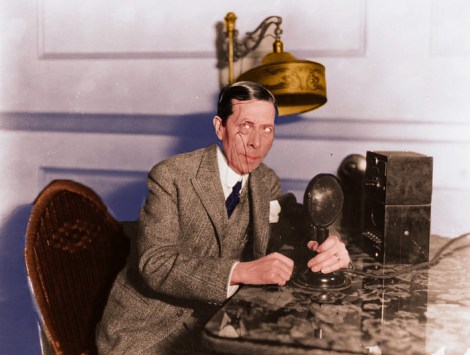
Mr. A broadcasts his opposition to movie censorship in Medford, Massachusetts on April 3, 1922. Newspapers stated that this broadcast was heard “as far west as Wisconsin and as far south as the Carolinas.” That’s Maude Howell listening in on the headphones:
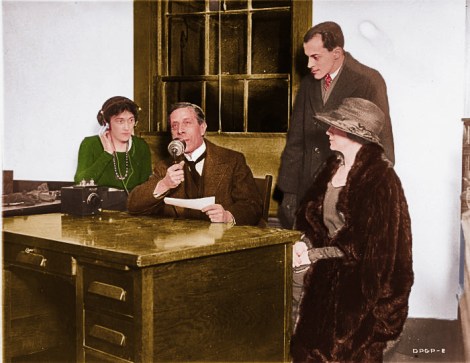
Arliss said, “The influences of the films were better for the young than the average methods of learning; that the conscience of boy or girl is a far better judge of right or wrong in the movies than the application of the censorship rod.”

George Arliss was President of the Episcopal Actors Guild of America from 1921 to 1938. Here he broadcasts a fundraising appeal on behalf of the unfinished Cathedral of St. John the Divine, over station WJZ in New York:

Station KWK in St. Louis, MO, was part of a national syndicated network on June 23, 1931, to broadcast another defense of Hollywood by Mr. A. The subject this time was the bad behavior of certain actors and actresses – some things never change:

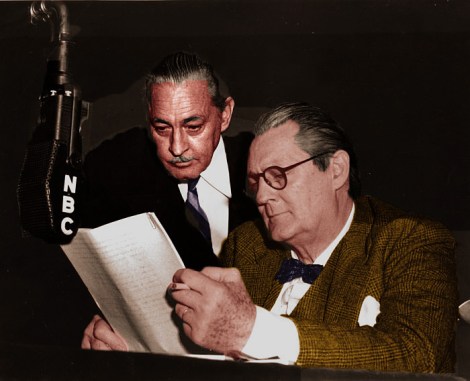
Fellow Warners star John Barrymore said he “didn’t think much of this radio thing” when he first participated in a broadcast in 1928 over station KFI in Los Angeles:

By 1941, the Great Profile derived most of his income from radio, here with his brother Lionel on the right:

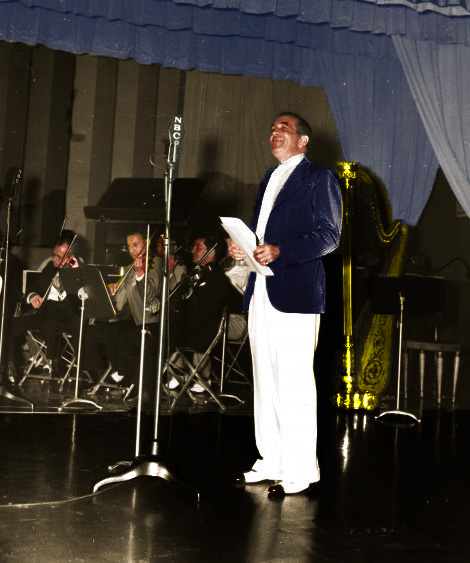
Warner colleague Al Jolson’s ebullient personality transmitted well and he starred in his own weekly show from 1932 on. Here he is rehearsing for an April 1935 Shell Chateau broadcast where his guests were Amelia Earhart and Babe Ruth:

Radio permitted another of Mr. A’s Warners colleagues, Edward G. Robinson, to tackle something he couldn’t do in movies – Shakespeare. Here he rehearses his role of Petruchio for an August 2, 1937 broadcast of THE TAMING OF THE SHREW:
Mr. Robinson was such a hit that by the Fall 1937 he began starring in his own weekly series, a newspaper drama, THE BIG TOWN, for the next six years.

At the age of 70, Mr. A made his dramatic broadcast debut on the Lux Radio Theater, hosted by Cecil B. DeMille, on January 17, 1938 in DISRAELI. He returned on March 21, 1938, in THE MAN WHO PLAYED GOD, and again on January 23, 1939, in CARDINAL RICHELIEU:
It was conservatively estimated that 30 million people heard each of Mr. A’s Lux broadcasts.

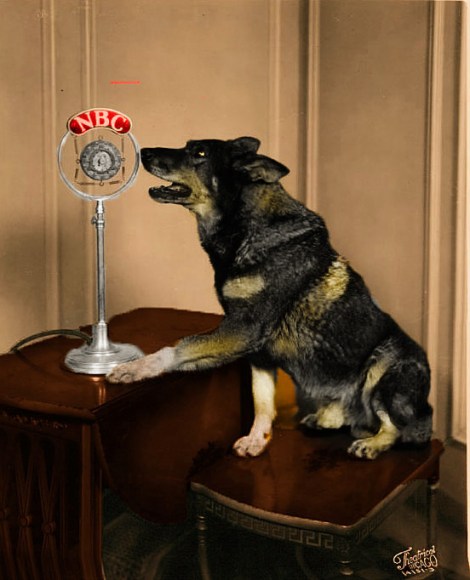
Greta Garbo was the only major film star never to perform on radio. Even Rin-Tin-Tin had his own weekly show in 1931:

The Forgotten Roles of the Stage

The theater triumphs of George Arliss have been enshrined in reasonably effective film versions – his personality being the raison d’etre to see them all. DISRAELI debuted in 1911 and was filmed in 1921 as a silent, and again in 1929 as a talkie. ALEXANDER HAMILTON debuted in 1917, filmed in 1931. THE GREEN GODDESS debuted in 1921, filmed in 1923 and 1929. OLD ENGLISH debuted in 1925, filmed in 1930. Between the years of these successes were many false starts – promising plays that didn’t succeed. Here we will take a look at some of these well-mounted but forgotten plays (with one exception) and the characters that Mr. A so carefully created for them.

THE DEVIL was a sly comedy written by Ferenc Molnar that served as Mr. A’s very first starring vehicle in 1908. Playing the title role, the Arliss production had to compete with other versions at the same time due to the lack of copyright protection for this particular play. But he managed to eke out a full season, first in New York and then on tour. Here’s some imaginative marketing to publicize the 1921 film version:

SEPTIMUS was based on a popular novel by W.J. Locke that became Mr. A’s second starring play for the 1909-1910 season. The title character was an absent-minded inventor who was so absorbed in his work he didn’t seem to mind giving up his true love. Audiences were not pleased:

Following the incredible five-year run of DISRAELI, 1911-1915, many prominent playwrights were offering their talents to craft Mr. A’s next vehicle. He got together with Edward Knoblock to create another historical portrait for the 1916-1917 season. This time it was the early 19th century violinist Nicolo Paganini. Friends told Mr. A that PAGANINI was “very interesting,” which he knew doomed the play’s chances to be a popular success. It lasted for 48 performances in New York:

After HAMILTON completed its two-year run beginning in 1917, Mr. A was again on the prowl for a play. A Philadelphia lawyer sent Arliss a play he had co-authored with a novelist about the 18th century philosopher Voltaire. Mr. A seems to have read every play sent to him by anybody and everybody. He added his own revisions to the script, uncredited, then obtained a producer’s promise to stage it for the 1919-1920 season.

But the producer reneged, perhaps fearing that VOLTAIRE was just another PAGANINI type of flop. Here is a tinted photo from the 1933 film that made a bundle for Warner Bros., a 29% profit over the combined production and distribution costs – and during the worst year of the Great Depression. Some producer in New York was probably kicking himself by then:

Booth Tarkington was a friend of Mr. A’s and wrote a topical post-World War I play concerning Bolsheviks in America in 1920. Mr. A played the title character in POLDEKIN and was supported in the cast by a young Edward G. Robinson, and a future Charlie Chan, Sidney Toler. But the comedy-drama of a Bolshevik who comes to love America was too offbeat for the temper of the times and it lasted only 44 performances in New York, despite the top-rated author and the star:
Despite the failure of POLDEKIN, the 1920s was an incredibly successful decade for George Arliss. He enjoyed back-to-back hits with THE GREEN GODDESS and then with OLD ENGLISH. By 1928 he was scouting for a new vehicle and his producer, Winthrop Ames, selected Shakespeare’s THE MERCHANT OF VENICE. Mr. A played Shylock:


The beautiful program cover for this play is undimmed by Time:

The choice of the play was actually made by Mrs. Ames whose husband gave her a choice for her birthday gift: either a pearl necklace she admired or the play. Mrs. Ames chose the play:

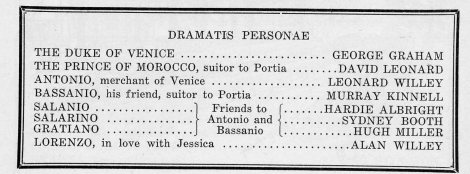
The cast included a number of actors who would appear with Mr. A in his 1930s films including Murray Kinnell (who later suggested that Mr. A hire an unknown actress named Bette Davis), Hardie Albright, Henry Morrell, and Romney Brent (misspelled in the program):

Portia was played by Peggy Wood, later the Mother Superior in THE SOUND OF MUSIC (1965), among other things. Spring Byington, who played Portia’s maid, later became a beloved character actress in movies and television:

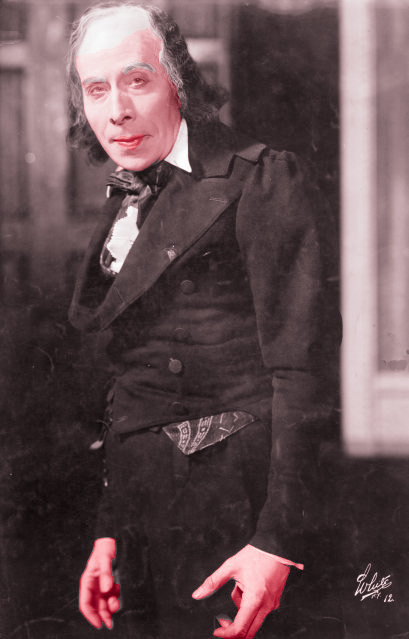
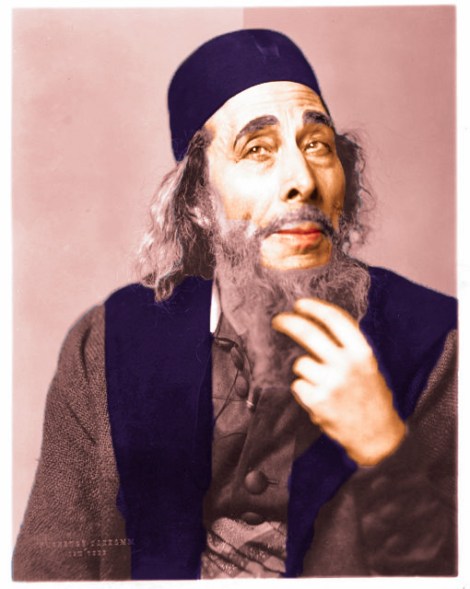
Mr. A would later try to persuade film producers to make THE MERCHANT OF VENICE into a movie, but they declined, perhaps owing to the stereotyping of Shylock. Mr. A said that Shylock was really the most honest character in the play – others were engaging in deception while Shylock said what he meant and meant what he said. But MERCHANT would not be made into a major film until Al Pacino played Shylock in 2004. Here’s another study of Mr. A:

THE MERCHANT OF VENICE did well in its New York run and was successful on tour throughout the United States, even as the Jazz Age reached its zenith. This play would mark Mr. A’s final appearance on the stage. During the play’s run in Los Angeles, Jack Warner and Darryl Zanuck visited Mr. A backstage to ask if he would be interested in making talking pictures – the rest is history.