For this year’s observance, we are doing things a bit differently than in the past. We are literally presenting a George Arliss performance that nobody has ever seen. At least, nobody living today. I am referring to Mr. A’s appearance as Shylock in Shakespeare’s The Merchant of Venice.
He played it thanks to the wife of his producer, Winthrop Ames. It seems they had a wedding anniversary coming up and Mr. Ames asked Mrs. Ames to choose between one of two gifts. The first was a string of valuable pearls. The second was a theater production of The Merchant of Venice. Mrs. Ames chose the play and to nobody’s surprise Mr. Ames selected George Arliss to portray Shylock.
The play toured the United States throughout 1928 and apparently into 1929. This would prove to be Mr. A’s final appearance on the stage. When he toured with Merchant in Los Angeles, he was approached by Jack Warner and Darryl Zanuck of the Warner Bros. motion picture studio to star in their new fangled talking pictures. The idea was to film some of his hit plays. Alas, while Mr. A would go on to film a number of his popular plays, The Merchant of Venice was not among them.
Aside from several splendid photographs, there is no recording, visual or audio, of George Arliss as Shylock. But thanks to the advent of AI (Artificial Intelligence) we can now see and hear Mr. A in full costume and makeup reciting Shylock’s famous Act III soliloquy. I’d call this a very special Treat for this year’s April 10th Birthday Observance.
I’ll remember 2024 as the year where I learned how to use AI software. This includes animating photos, voice cloning, and writing “text-to-speech” material for my favorite subjects. The fruits of my labors have been posted here and elsewhere on the ‘net depending on the subject matter. My efforts also pressed me to upgrade my knowledge of colorizing images that I have slowly become competent with over the past several years.
Without further ado, here is a sort of Christmas present to our many Arliss fans who have stopped by over this year to learn what is new with Mr. A. I hope you enjoy this turn at reading poetry. And best wishes for the New Year!
Looking ahead I find myself wondering what’s next? We know that Mr. A did well in Shakespeare’s “The Merchant of Venice” playing Shylock. But he never repeated the character in films or on radio. Might AI enable us to have his Shylock recite one of the memorable speeches from the text. Imagine what may lay ahead for us in 2025!
The “voice” is an AI generated clone copied from a recording of Mr. Arliss’s actual voice.
GA discusses the differences between acting in the theater and acting before the camera in silent films. The text has been adapted from an interview that GA gave titled, “Stars of Two Orbits” from the January 1922 issue of Filmplay Journal.
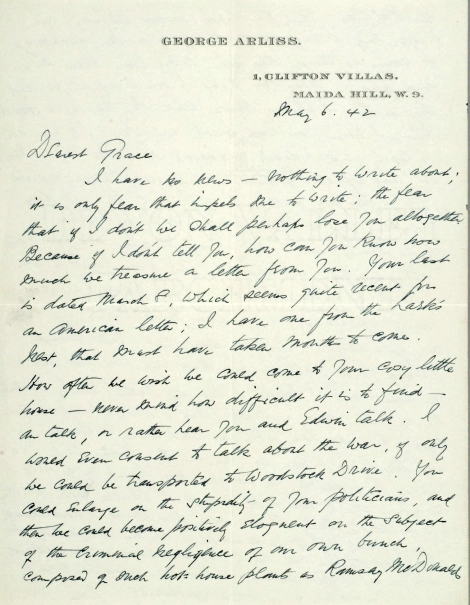
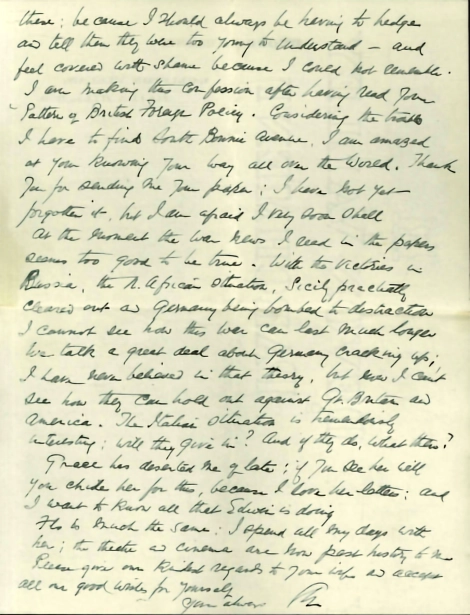
GA becomes nostalgic for the pre-war days and wonders if these will ever return. At the time he wrote this letter to Grace Hubble, wife of famed astronomer Edwin Hubble, the war was not going well for the Allies who were suffering serious setbacks in both the European and Pacific theaters:
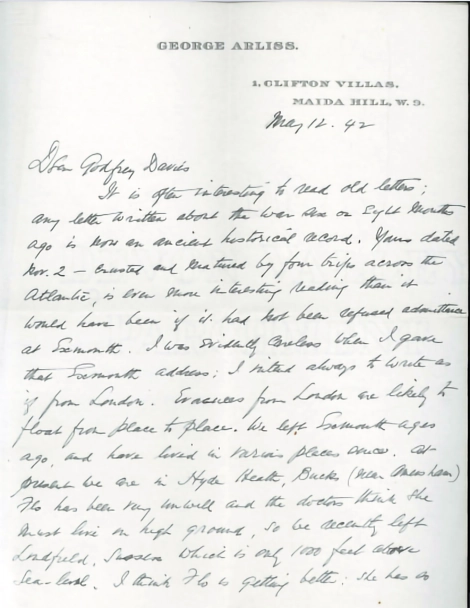
A few days later GA wrote this letter to historian Godfrey Davies who lived in California. The Arlisses are living away from London due to German bombing attacks and GA relates the poor state of Florence’s health, especially her eyesight.
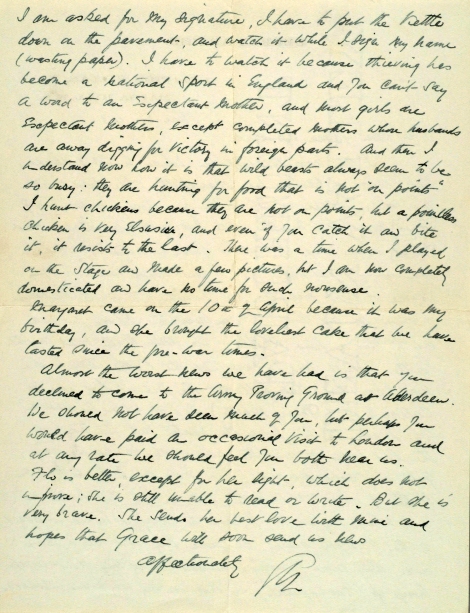
A month later GA writes again to the Hubbles and he’s more upbeat, joking to Edwin that Grace is treating him “shamefully.” Noting his appreciation for how busy Edwin must be, GA relates that he too is busy – trying to buy a new kettle. GA also comments of the “points system” involved in food rationing:
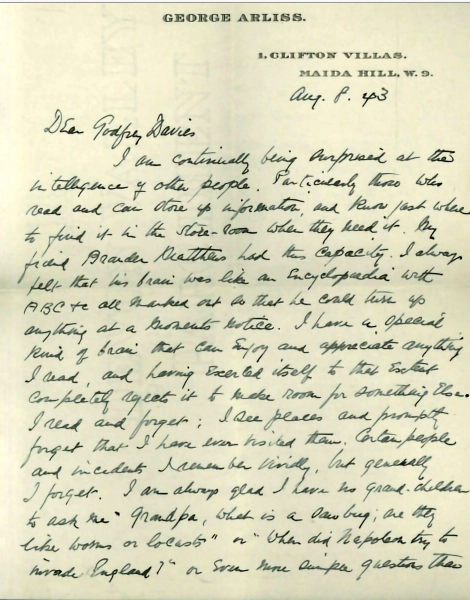
GA discusses his short term memory loss and how it is just as well that he doesn’t have any grandchildren because he would not be able to answer their questions. He closes by commenting on the war news and the defeats suffered by Germany:
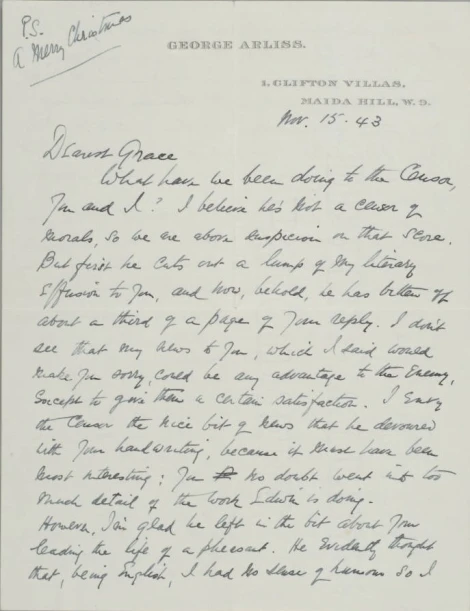
By November 1943, the war news was getting better and the common wisdom suggested that the war was certain to be over soon. GA notes how the postal censors interfere with people’s correspondence by literally cutting out parts of the writing that are judged too sensitive. He refers to news that would make Grace “sorry.” No doubt he was referring to the destruction of his cottage at St. Margaret’s Bay that was hit by a German shell the previous year.
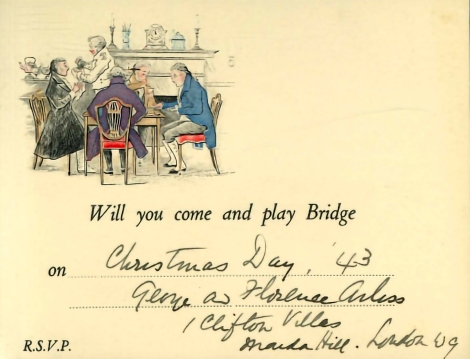
As 1943 was coming to end there was widespread optimism that the war would certainly end during 1944. Perhaps as a sign of the times, GA sent this playful invitation to Godfrey Davies, who was living in California, to drop by GA’s London home on Christmas Day to play some bridge:
The colorization of black and white photographs has come a long way since I first tried my hand at it over a decade ago. The software has improved quite a lot and the results are impressive. But make no mistake, the quality of the finished product depends in large part on the skill and judgment of the colorist.
Recently, I received a half dozen colorized portraits of George Arliss that were created by Alexander Marani-Binks. These are stunning and I promptly asked Mr. Marani-Binks for permission to post his work here on the Arliss Archives. Permission was graciously granted. Here more or less in chronological order are these splendidly eye-catching portraits of our beloved Mr. A.
This 1919 portrait is the earliest one of the group. Mr. A had made a name for himself by starring in DISRAELI for five consecutive years from 1911 to 1915, plus a revival in 1917. By 1919 he was appearing regularly in New York and toured extensively throughout the United States. But, alas, a play as long-running as DISRAELI eluded him.
In those years, before and after the First World War, Mr. A plied the Atlantic each year from London to New York to earn his living. Unsurprisingly, there are many photos of him shipboard during his trans-Atlantic journeys. This one dates from about 1923 where he traveled to London to star in the hit play, THE GREEN GODDESS, from September 1923 to September 1924.
During this time Mr. A also made a half-dozen silent films that were all critical and financial successes. By the end of the 1920s, a major breakthrough occurred with the sudden popularity of sound films, i.e., talking pictures. Mr. A made his talkie debut with his reliable old warhorse that never failed him, DISRAELI. The Motion Picture Academy of Arts and Science expressed its appreciation of his work in the film by presenting Mr. A with the Academy Award for Best Actor.
This film’s financial and critical success led to a series of ten feature films that Mr. A made for Warner Bros. One of his humorous stories was called A SUCCESSFUL CALAMITY released in 1932. Mr. A played the father of a family much in the way that Robert Young would play a similar role later in the long running television show, FATHER KNOWS BEST.
Though he was nearing 70, Mr. A decided to tackle network radio broadcasting in addition to filmmaking. In the 1930s network shows were performed “live” and the process could be nerve-racking for movie stars who were used to working in the privacy of a closed studio set. But since Mr. A had been performing “live” before audiences since the 1880s, broadcasting held no fear for him.
In this photo from January 17, 1938, Mr. A appears with fellow actor Edward Arnold on the hour-long “Lux Radio Theater” where he reenacted his famous role as British prime minister Benjamin Disraeli. In fact. most the 1929 film’s cast were reunited for this radio presentation including Mr. A’s wife, Florence, who had played the role of Mrs. Disraeli since 1911.
Finally, our review of some highlights in Mr. A’s professional life ends with this characteristic portrait of him with his beloved monocle. He admitted that early in his career the use of a monocle was merely to attract attention and was not needed for vision. But in later life, he realized that wearing his monocle had become a necessity that had a real purpose. Somehow, when anybody mentions George Arliss, this is the image that most people think of:
Once again, I want to thank Alexander Marani-Binks for allowing me to post his work here and also to assure him that any time he wishes to creates addition Arliss color portraits, they will always be welcomed here!
I’m happy to announce my new book, A Faustian Pact: George Arliss and his $4.8 Million Lawsuit. This is a courtroom drama that I had heard about, but I thought I’d never write it due to a lack of material. But lo and behold I came across a transcript of the 1917 trial online with the verbatim testimony of all the witnesses, including the defendant, director Herbert Brenon, plus the sparing between legal counsel, and an increasing lack of patience from the judge. A fun read with a very satisfying ending. Available on Amazon in Kindle and paperback. If you belong to Kindle Unlimited you can read it for free.
Check your listings to watch these two George Arliss Classics during the first week of April.
On April 1st is GA’s Best Actor Academy Award winning film, DISRAELI . An early talkie filmed during the stifling summer of 1929, and based on GA’s amazing 5-year theater run of the play, DISRAELI is told through a delightful series of intimate conversations that lead to a spellbinding climax.
The plot involves the British prime minister’s efforts to purchase the Suez Canal from Egypt before Russia can get its hands on it. This sounds, well, esoteric, doesn’t it? But therein lies the power of this film (and why the play ran for five years, plus two revivals, a 1921 silent film version, and also a 1938 radio adaptation that was heard live around the world).
Tune in on April 1st to discover what all the excitement was about.
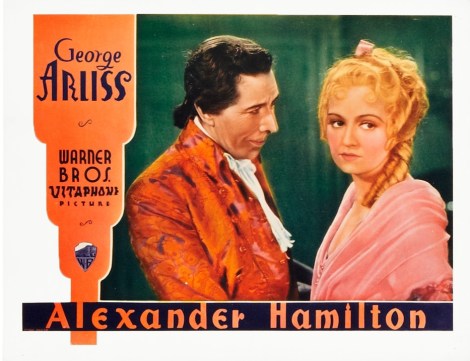
Next on Friday, April 7 at 4:15 PM EDT is the “first version” of the recent hit Broadway musical, HAMILTON. GA co-wrote the play – no musical numbers in this version – that tells the story of the first Secretary of the Treasury’s extramarital affair. When this film was made in the Spring of 1931 it was decided to rename it ALEXANDER HAMILTION, perhaps to avoid confusion with the British Lord Hamilton and his extramarital affair. Is this movie dry stuff? We think not. Check it out yourself.
This card dates from World War II and was sent to Drusilla Pierce, one of the Arlisses’ California friends. Written in Mr. A’s distinctive handwriting, a comment on the left side states, “(Dictated) Flo has trouble with her eyes and can no longer read or write. I am her secretary, Geo”
The main note states, “Drusie, We have just got your Xmas card. We are not sending out any cards this year, but this is just to acknowledge yours. We get very homesick for America and our old friends. It makes us happy to know that you remember us. With love from both of us.”
Up above Mr. A signs both for himself and Florence. Though undated, I would guess that this card was sent in late 1942 and 1943.
Actor, author, playwright, and filmmaker George Arliss was born in the Bloomsbury section of London on Good Friday, April 10, 1868. He made his professional stage debut in 1887, a time when theaters were lit by gaslight. Crossing the Atlantic in 1901 as a member of the Mrs. Patrick Campbell Company, George and his wife Florence eventually established themselves in the U.S. theater world. What was planned as six months stay turned into 20 years. Turning 60 in 1928, retirement seemed to be calling Mr. A, but so were talking pictures. Thus, he suddenly embarked on ten years in the studios (a phrase he used for the title of his second volume of memoirs) winning the Academy Award for Best Actor in the process. Today, at least seven of his films can be viewed on DVD and streaming video.









 ARLISS ARCHIVES
You must be logged in to post a comment.